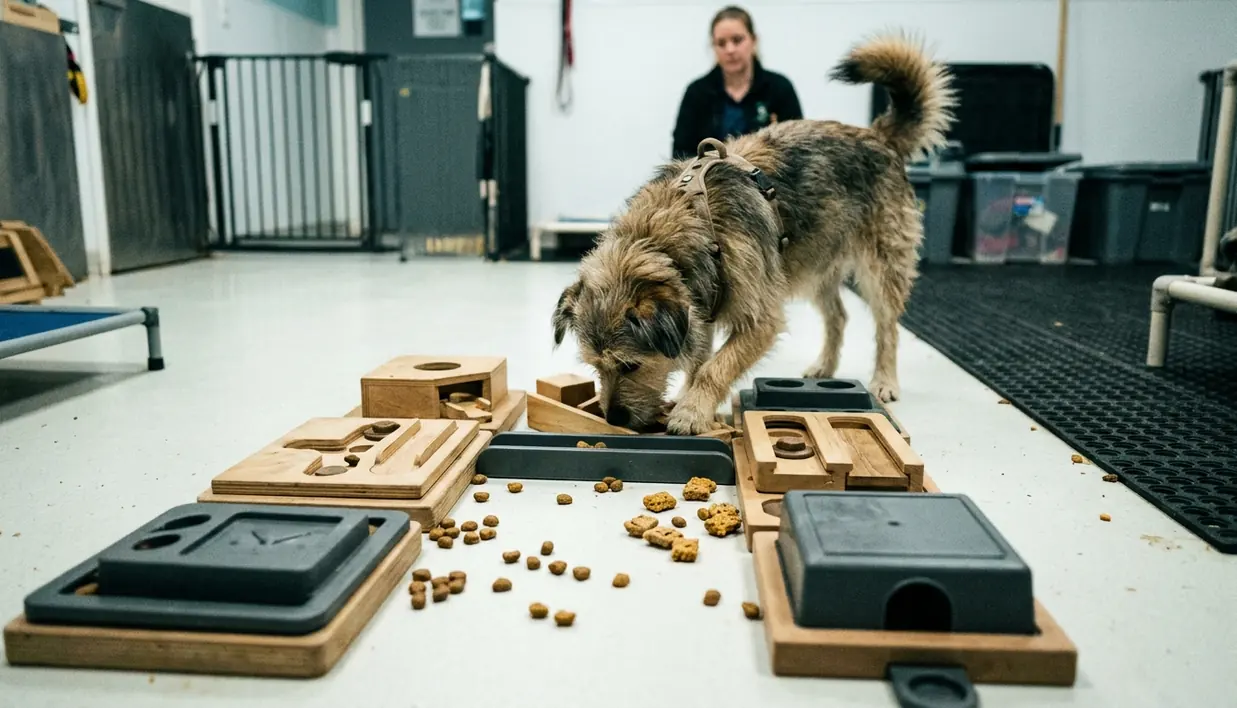
Cognitive enrichment is no longer a fringe topic in canine welfare. It sits at the center of how behavioral specialists now think about the indoor lives of domestic dogs—particularly in dense urban settings where physical space is limited and mental understimulation accumulates quietly. Interactive puzzle toys have a specific role here: they engage the brain through structured problem-solving rather than raw physical exertion.
The Science of Canine Cognitive Enrichment
Cognitive enrichment refers to activities that require a dog to process information, make decisions, and solve problems in order to obtain a reward. Biologically, this matters because the domestic dog retains the neural architecture of a foraging predator. The brain expects to work for food. When that expectation goes unmet for weeks or months, the consequences are not abstract.
The correlation between low mental stimulation and destructive behavior is well documented in applied behavioral literature. Dogs deprived of problem-solving outlets frequently redirect that unused capacity into chewing, excessive vocalization, or compulsive pacing. The behavior is not defiance. It is an animal generating its own enrichment in the absence of a structured one.

Problem-solving activities engage two regions in particular. The olfactory system drives the search itself—scent is the dog's primary investigative sense, while the prefrontal cortex handles sequencing, impulse control, and the working memory needed to recall which compartment held the reward. Engaging both produces measurable physiological effects.
Sustained olfactory foraging for 15 to 20 minutes, give or take, can elevate a dog's heart rate and respiratory rate to levels comparable to a brisk one- to two-mile walk.
That equivalence changes how puzzle time should be valued. Behavioral specialists structuring enrichment protocols often determine session duration by monitoring the dog's respiratory rate directly, halting the activity once rapid panting signals that the cognitive and physical load has peaked. For readers wanting a broader foundation, Texas A& M's veterinary program outlines additional cognitive enrichment strategies for dogs.
Evaluating Puzzle Toy Mechanics and Material Safety
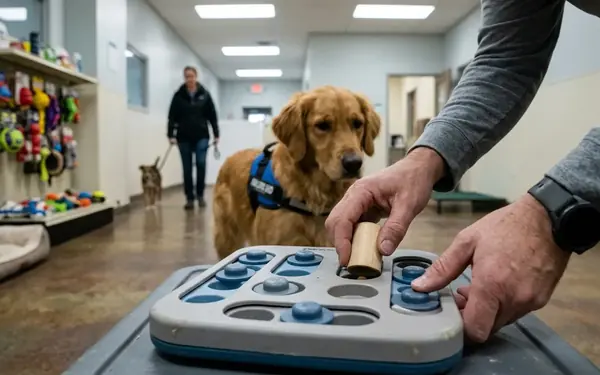
Four mechanical designs dominate the market: sliders, lifters, rollers, and hidden compartments. Sliders ask the dog to move a panel laterally to expose food. Lifters require raising a flap or cup. Rollers dispense kibble through motion. Hidden compartments combine several actions in sequence. Each design recruits a different motor skill, and the better products layer these skills deliberately rather than relying on one repeated gesture.
Material safety criteria
Durability and safety are not the same question, though they overlap. Early durability testing leaned toward rigid acrylics for their shatter resistance, but attention later shifted toward high-density polyethylene (HDPE) and food-grade thermoplastics, which absorb impact and resist cracking under repeated chewing. The practical criteria for a safe toy come down to three points:
- BPA-free plastics that will not leach compounds into saliva or food residue.
- Sustainable, sealed wood finished without toxic varnishes, suitable for light-duty puzzles.
- Shatter-resistant composites for dogs that treat solving as a demolition project.
The tiered difficulty system
Most reputable manufacturers grade puzzles across four levels. Level 1 involves a single obvious action. Levels 3 and 4 demand layered problem-solving. The mechanical jump is substantial: Level 3 and 4 puzzles typically incorporate dual-action mechanisms, requiring a dog to depress a spring-loaded lever with roughly 2 to 3 pounds of pressure before a sliding compartment can be manipulated.
Matching the toy to the dog's baseline ability is the single most important decision an owner makes here. A puzzle pitched far above a dog's current skill produces frustration, not enrichment—and frustration is precisely what these toys are meant to prevent.
Scope and Limitations of Interactive Toys
Puzzle toys are supplementary. They do not replace physical exercise, structured walks, or the relational time that builds a secure human-canine bond. An owner who substitutes a feeder puzzle for a daily walk has solved the wrong problem.
Resource guarding deserves explicit attention. Some dogs become protective over a puzzle precisely because it concentrates high-value food in one defended object. Behavioral consultants assessing guarding risk often watch the final 30 seconds, more or less, of puzzle completion, reading body language for stiffening, hovering, or accelerated eating. Supervised play is therefore not optional for dogs with any guarding history.
There is also the matter of intelligent breeds outpacing the toy.
Working breeds like Belgian Malinois and Border Collies frequently memorize the sequential steps of a Level 2 puzzle within three to four exposures, reducing the cognitive load and turning the activity into a purely mechanical feeding exercise.
The remedy is rotation. A library of three or four puzzles, cycled rather than left out continuously, preserves novelty and keeps the prefrontal demand alive.
Risk Factor: High-value treats used in puzzle toys must be subtracted from the dog's daily caloric intake to prevent rapid weight gain, particularly in breeds prone to metabolic issues. Enrichment should never arrive as a hidden surplus of calories.
Top Interactive Puzzle Toys Reviewed by Difficulty
Reviewers categorize toys by counting the distinct motor skills required—pawing, nudging, lifting—and reserve the Level 3 label for designs demanding at least two different actions in sequence. The following groupings reflect that logic.
Level 1: Puppies and senior dogs
Entry-level toys rely on simple nudge-and-reveal mechanics. The dog pushes a piece, food appears, the association forms quickly. These are ideal for puppies building confidence and for senior dogs whose dexterity or vision has declined. Entry-level slider toys feature tracks with a half-inch clearance in manufacturer specifications to prevent claw entrapment—a small specification that prevents a painful, trust-eroding accident.
Level 2: Paw-and-nose coordination
The intermediate tier introduces sliding blocks and flip-lids that require coordinated use of paw and nose. The dog must lift one element while stabilizing another. This is where most average pet dogs spend their productive puzzle lives, and where the rotation strategy mentioned earlier becomes relevant for quicker learners.
Levels 3 and 4: Sequential problem-solving
Advanced puzzles feature locking mechanisms and multi-layered steps. Some advanced locking puzzles use recessed pegs that require a precise 45-degree upward lift using the incisors—a fine motor task that not every dog can perform.
Recommendation: Dogs with brachycephalic facial structures, such as Pugs or French Bulldogs, often fail to operate deep-recessed peg puzzles because their shortened muzzles prevent them from gripping the lifting mechanisms, leading to frustration rather than enrichment. Match the mechanism to the muzzle before assuming the dog lacks intelligence.
One environmental variable is easy to overlook. The effectiveness of a sliding puzzle depends heavily on the flooring surface; toys lacking high-friction rubber gaskets will slide across hardwood floors, forcing the dog to chase the toy rather than solve the cognitive puzzle. A non-slip mat resolves this in seconds.
Implementation: Introducing Puzzles to Prevent Frustration
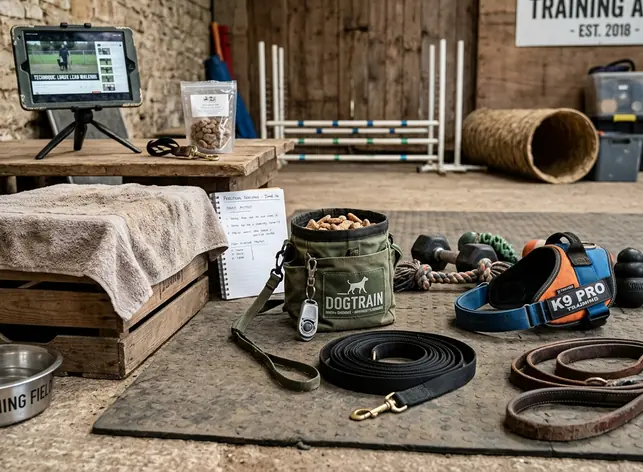
Introducing a new puzzle well determines whether the dog learns to love the object or learns to avoid it. The principle that guides this process is errorless learning: arrange the early sessions so the dog cannot fail, then raise difficulty only after success is consistent.
- Start fully open. Place food in open compartments with no lids or sliders engaged. Let the dog eat freely and associate the object with reward.
- Add one obstacle. Trainers introduce closed lids or sliders only after the dog reliably eats from the open configuration—never before.
- Stay present. Quiet encouragement keeps the dog working; silence or hovering can read as pressure.
- Increase difficulty gradually. Move up one mechanism at a time, confirming success at each stage.
Troubleshooting two failure modes
Some dogs quit early. Others escalate toward destruction. Both signal that the difficulty exceeds the dog's current capacity. The intervention threshold is concrete: if a dog begins digging or biting at a puzzle mechanism for somewhere around 12 to 15 seconds without success, trainers intervene by resetting the puzzle to an easier configuration to prevent the onset of frustration-induced destructive behavior.
The dog that gives up needs an easier win to rebuild momentum. The dog that bites needs the same reset, delivered before the chewing becomes a habit in its own right. In both cases the answer is to lower the bar, not to push harder.
Bottom line: A puzzle toy succeeds when the dog finishes a session calmer and more satisfied than it began—not merely fed. Difficulty is a means to engagement, never the goal itself. The recommendations here reflect general behavioral principles; individual dogs vary in dexterity, drive, and tolerance, so observe your own animal rather than treating any level rating as a fixed prescription.