The Science of Canine Cognition and Fatigue
A common assumption among owners of working breeds is that a tired dog requires a longer walk. The physiology suggests otherwise. Physical exhaustion and cognitive fatigue draw on different reserves, and for breeds engineered to herd, retrieve, or track across long days, repetitive locomotion alone rarely satisfies the brain that drives the behavior.
Consider what happens during focused scenting. A dog's respiration climbs from a resting baseline of somewhere around 15 to 30 breaths per minute to somewhere between 140 and 300 breaths per minute. That spike is not exertion in the muscular sense—it is the metabolic signature of intense neurological work.
The olfactory system explains why. The canine olfactory bulb processes scent through a dedicated pathway that bypasses the thalamus, the structure that ordinarily filters and relays sensory input. Scent information arrives raw and demands considerable energy to interpret. A dog asked to locate hidden food is performing thousands of micro-decisions per minute, and that decision load drains energy reserves far more efficiently than a predictable jog around the block.
This connects to a behavioral concept worth naming: contrafreeloading. Across numerous species, animals offered identical food in two conditions—one free in a bowl, one requiring effort to obtain, will frequently choose the effortful option. The work itself appears to hold intrinsic value. For high-energy dogs, this preference is the lever that mental enrichment pulls. Reputable veterinary behavioral research on cognitive fatigue supports building daily routines around this principle.
Criteria for Selecting Effective Enrichment Games
The games that follow were not chosen at random. Each had to satisfy two non-negotiable criteria before earning a place on this list.
Criterion 1: High Cognitive Load
A worthwhile game forces active decision-making. The dog must evaluate options, test strategies, and adjust based on outcome—not simply repeat a memorized motion. Tasks that become rote stop draining mental energy, which is why rotation and variation matter as much as the toy itself.
Criterion 2: Safety and Durability
The selection process here was unforgiving on materials. Several complex electronic treat dispensers were evaluated and then excluded, because testing revealed that aggressive chewers could crack the hard plastic housing within three to five minutes. A puzzle that fragments under jaw pressure is an ingestion hazard, not an enrichment tool.
The working standard: any puzzle toy intended for working breeds should feature a minimum material thickness of something like 4mm in natural rubber or heavy-duty composite. That threshold withstands the jaw pressure these dogs generate without splintering.
Scent Work and Foraging Exercises
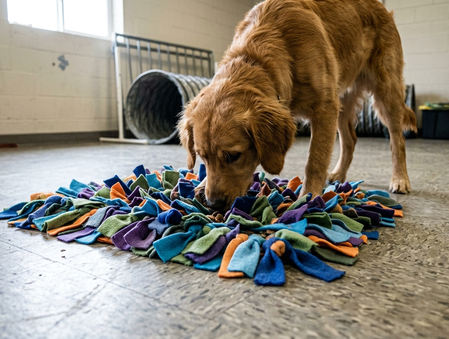
Scent-based games carry a secondary benefit beyond fatigue. Focused sniffing lowers heart rate and shifts a dog into a calmer, more regulated state. The activity is mentally taxing and physiologically settling at the same time.
1. Advanced Snuffle Mat Foraging
The basic snuffle mat hides kibble in fabric strips. The advanced version layers value. Bury a small number of high-value treats—freeze-dried liver, for instance, deep within the densest sections, then scatter lower-value kibble through the shallower strips. The contrast in reward forces the dog to keep searching past the easy finds rather than abandoning the mat after the first success.
A properly layered mat should sustain continuous foraging for eight to twelve minutes, give or take. If your dog clears it in two, the treats are too accessible.
2. The 'Find It' Scent Trail
This exercise builds a trackable path through the home. Dilute one drop of a dog-safe essential oil, such as lavender or chamomile, into two cups of water—a concentration low enough to avoid overwhelming sensitive olfactory receptors. Meat broth works as an alternative for dogs who respond better to food scent.
- Begin in a single room. Lay a short trail of scent dabs leading to a hidden reward.
- Once the dog reliably follows the line, extend the trail through a doorway into a second room.
- Progress to multi-room searches, increasing the distance between scent markers.
One practical note on surfaces: scent trails dissipate much faster on sealed hardwood floors than on high-pile carpets. If your dog struggles indoors, the flooring may be working against you rather than the dog losing the thread.
Problem-Solving and Puzzle Challenges
3. Interlocking Treat Dispensers
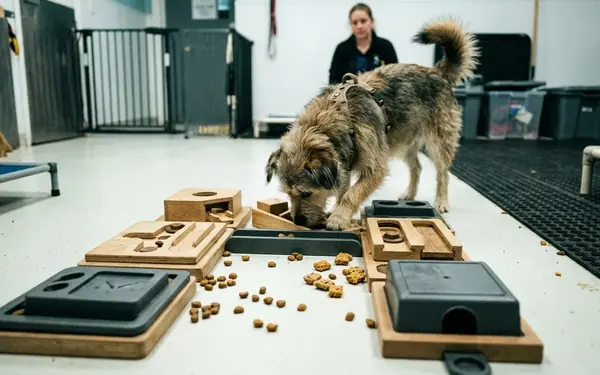
Commercial sliding-block puzzles ask the dog to manipulate compartments to release food. Their weakness is predictability. Dogs develop muscle memory, and a memorized solution carries almost no cognitive load.
Rotate these puzzles every three to four days. The rotation keeps the task novel and preserves the mental challenge that justified buying the puzzle in the first place. Watch for a particular failure mode—some dogs flip the board entirely rather than engage the sliding mechanisms. A heavier base or a non-slip mat underneath usually corrects this.
4. The Muffin Tin Shell Game
This DIY test requires only a standard baking tin and tennis balls. Drop kibble into a few of the cups, then cover every cup with a tennis ball. The dog must move the balls to reveal which cups hold food, recruiting paw-eye coordination and a degree of working memory.
Frustration is the risk here. If a dog paws frantically at the same spot for fifteen to twenty seconds without success, intervene before that frustration redirects into destructive chewing. Nudge a ball loose, reward the small win, and let confidence rebuild before raising difficulty.
Impulse Control and Obedience Games
Cognitive load is only half the picture. The games below train emotional regulation—the capacity to stay composed under excitement, which translates directly into a calmer dog at home.
5. Structured Tug-of-War with Drop Commands
Tug is high-arousal by design, and that is precisely why it teaches impulse control. The game pairs intense excitement with a demand for immediate compliance. After each 'drop' command, require a calm sit of three to five seconds before re-initiating play. The dog learns that arousal and self-control coexist.
One catch: high-arousal tug games can overstimulate herding breeds if the 'drop' command isn't strictly enforced, leading to nipping rather than emotional regulation.
6. The 'Wait and Release' Obstacle Course
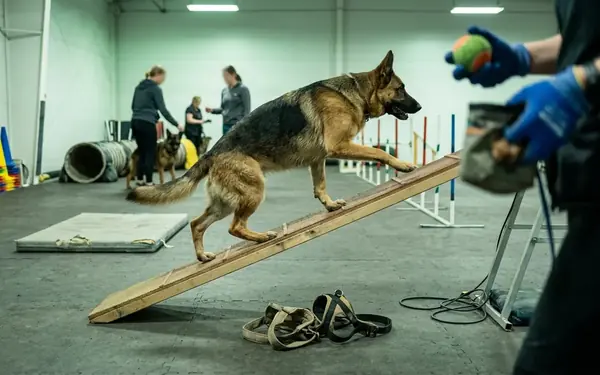
Set up low-impact indoor stations and space them four to six feet apart—enough distance for the dog to build momentum before being asked to halt. At each station the dog holds a 'stay' until you issue a specific release word, then moves to the next. The course rewards patience under motion, which is far harder for a high-drive dog than holding still in a quiet room.
Scope and Limitations of Mental Enrichment
Enrichment is a supplement, not a substitute. High-energy working breeds still require a baseline of 45 to 90 minutes of aerobic physical movement daily, adjusted for age and joint health. No puzzle replaces that biological need.
The boundaries matter for honesty as much as for results. Cognitive games will not cure clinical separation anxiety or neurological hyperactivity. Those conditions warrant professional veterinary intervention, and enrichment alone—however well designed, should not be framed as treatment for them.
Based on participant feedback, owners typically observe a lower baseline arousal in the home after 14 to 21 days of consistent daily enrichment. The change is gradual and cumulative, not overnight.
Critical Insight: Enrichment shapes a dog's daily energy budget; it does not rewrite underlying clinical or breed-driven physiology. Treat it as one input among several, paired with exercise, structure, and veterinary guidance where the behavior warrants it.
Integrating Enrichment into Your Daily Routine

The simplest structural change costs nothing: allocate the entire morning kibble ration toward enrichment games rather than a standard bowl. Breakfast becomes a foraging task, and the dog earns the meal it would otherwise inhale in seconds.
Keep intense cognitive sessions to 10 to 15 minutes. Pushing past that invites mental exhaustion and, worse, disinterest in the games themselves.
Sample Daily Enrichment Schedule for High-Energy Breeds| Time of Day | Activity Type | Duration | Primary Goal |
|---|---|---|---|
| Morning (Pre-Work) | Muffin Tin Shell Game (using breakfast kibble) | 10–15 mins | Mental fatigue before owner departure |
| Mid-Day | Brisk aerobic walk | 45–90 mins (split as needed) | Baseline physical exercise |
| Evening | Scent trail or structured tug with drop commands | 10–15 mins | Impulse control and calm settling |
Recommendation: Split the aerobic requirement across two shorter outings if a single long walk does not fit your schedule. The total movement matters more than its arrangement.
What these games build, beyond a tired dog, is a working partnership. Cooperative problem-solving—the dog testing a strategy, you adjusting the challenge, deepens the trust that makes every other part of training easier. A high-energy dog is not a problem to be drained. It is a capable mind asking to be put to work.