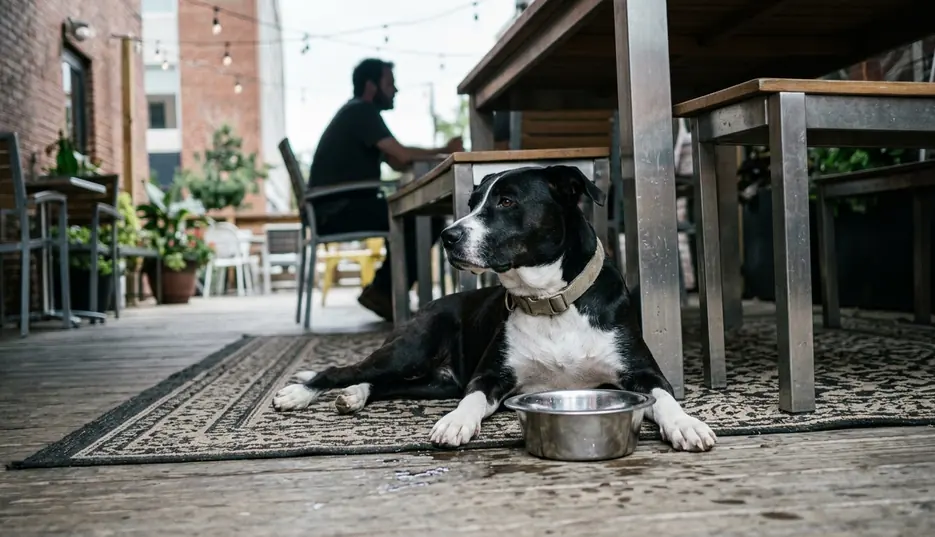
A warm Thursday evening in Cooper-Young, the barbecue smoke drifting sideways across the sidewalk, string lights buzzing over a dozen full tables. Under a wrought-iron table near the rail, a brindle mutt lies flat on her side, one ear tracking the waiter's footsteps, the rest of her entirely uninterested. She has been there more or less forty minutes. Nobody at the neighboring table has noticed her.
That dog is the exception, and she got there through work.
A Midtown Evening: The Rise of Canine Companions in Memphis Dining
Memphis patios have quietly become a second living room for a lot of households. Breweries along Broad Avenue, coffee counters downtown, and full-service kitchens in Midtown now field dogs on a nightly basis, and the culture has shifted faster than most owners' training plans have. The desire to bring the dog is nearly universal. The preparation is not.
The friction sits in three places at once: what the health code permits, what the dog's nervous system can tolerate, and what the surrounding diners are willing to absorb. Cooper-Young patios at peak hours stack ambient noise, overlapping food scents, and constant foot traffic into a single sensory environment. Wrought-iron table bases, common across the neighborhood, offer almost no physical barrier for a resting dog, which means the handler becomes the barrier by default.
None of that makes patio dining unrealistic. It makes it a skill with prerequisites.
Navigating Shelby County Health Regulations for Outdoor Seating
Before behavior enters the conversation, the physical layout of the venue does. Shelby County health parameters govern where live animals may be present at a food service establishment, and the controlling logic is separation from food preparation and indoor dining. In practice this means a patio must have a separate exterior entrance. A dog cannot be walked through the dining room to reach the outdoor seating, regardless of how quiet or well-mannered the animal is.
A second parameter surprises people constantly: dogs must remain on the floor. Chairs, benches, and tabletops are off-limits, without exception for size or breed. The small dog lifted into a lap for a photograph is a code issue, not a courtesy issue.
These county provisions sit downstream of broader federal food safety guidelines regarding live animals, which establish the baseline framework most jurisdictions adapt.
Revocable Patio Privileges
One catch worth internalizing before the first outing: county guidelines set a floor, not a ceiling. Individual restaurant management retains full authority to enforce stricter policies or withdraw patio privileges entirely, based on capacity, liability exposure, or a single bad incident on a busy Saturday. Regulatory permission and venue permission are separate questions, and the second one can change between visits.
Evaluating Canine Sensory Thresholds for Public Environments
When we first built a patio-readiness assessment, the criteria leaned on obedience commands: a clean sit, a held stay, a reliable down. That framing came apart quickly. Dogs were holding rigid positions while their bodies broadcast escalating stress — panting without heat, whale eye, a tail clamped tight against the hock. Compliance was masking arousal. The assessment now measures recovery instead of obedience.
The useful benchmark is autonomic arousal recovery: after a startle, how long before the dog returns to baseline? In that assessment, a functional recovery window is somewhere around 45 to 90 seconds. A dog that flinches at a dropped fork, orients, then resettles inside a minute and a half is operating within threshold. A dog still scanning the patio four minutes later is not relaxing, it is monitoring.
Restaurant environments are unusual because the stimuli overlap rather than arrive in sequence. Dropped silverware, a chair scraping concrete, a waiter passing within eighteen inches, another dog two tables over, and the smell of a brisket plate can all land inside the same ten-second window. Each item alone might be trivial. Stacked, they push cumulative arousal past what a dog can discharge while lying still.
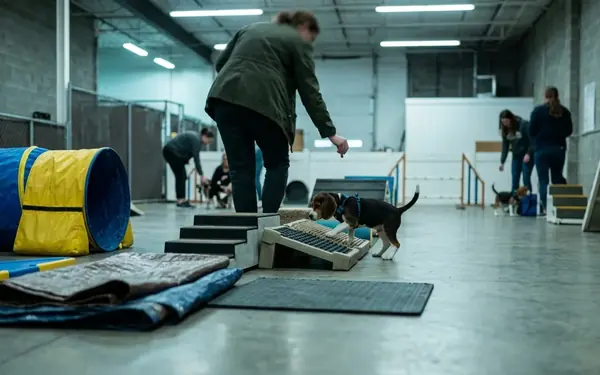
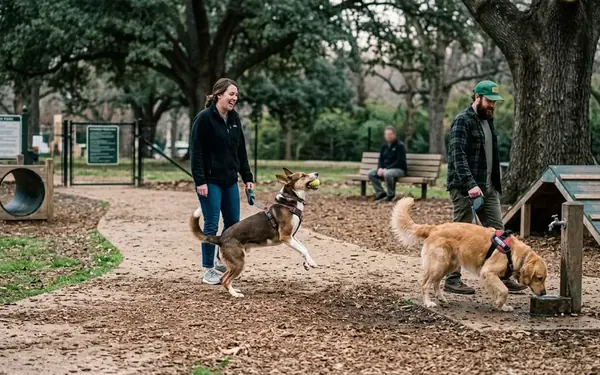
Behavior modification for reactive or anxious dogs belongs in low-stakes settings first. Counter-conditioning at a distance, at a quiet park, at an hour with light traffic. The patio is the exam, not the classroom.
Recovery Beats Compliance
A dog that can perform commands under stress is not the same as a dog that can rest under stress. Watch the recovery clock, not the obedience record.
Selecting the Right Venue: Breweries, Cafes, and Full-Service Patios
Venue selection does more work than most owners expect, because environmental intensity varies enormously across a few miles of Memphis.
Craft Breweries
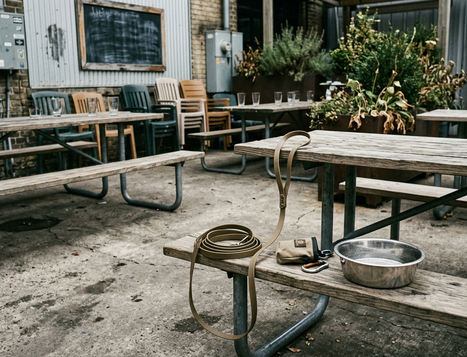
Brewery courtyards, common in the Broad Avenue Arts District, typically arrange long picnic tables with 6 to 8 feet of spatial buffer between groups, give or take. That distance is the single most valuable variable for a dog still building tolerance. It gives a handler room to increase separation without leaving, and it keeps passing bodies outside the dog's immediate personal space.
The tradeoff is acoustics. Concrete floors and metal roofing generate echo, and a dog that is faultless in a carpeted living room can bark steadily at a brewery simply because the sound reflects in a way it has never experienced. Handlers who blame temperament here are usually looking at an architecture problem.
Full-Service Restaurant Patios
Downtown and Midtown full-service patios run tighter, frequently something like 24 to 36 inches of clearance between chairs. Servers navigate that gap carrying hot plates. A dog's tail extending into the lane becomes a genuine hazard rather than an etiquette lapse. These spaces suit dogs with established settling behavior and a low startle profile.
Cafes and Coffee Counters
Sidewalk cafe tables on a weekday morning represent the gentlest entry point available: short visits, predictable traffic, easy exit. The same dog might handle a quiet Tuesday evening cafe stop without a flicker and then unravel completely at a Saturday afternoon brewery event with live music. Timing is a variable in its own right.
Equipment and Protocols for Successful Patio Settling
Gear is minimal and non-negotiable.
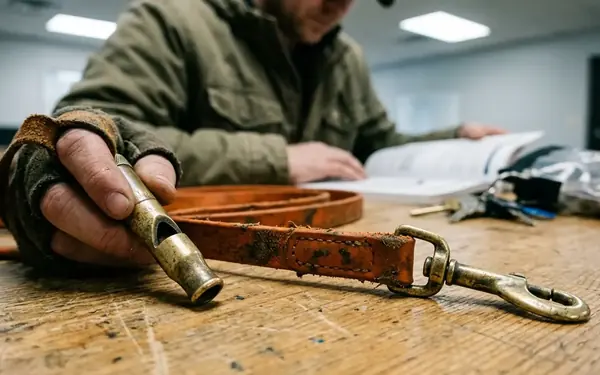
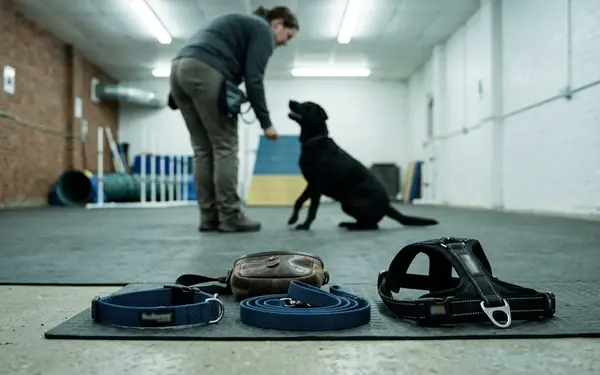
- A 4-foot fixed-length biothane leash. Fixed length permits immediate spatial correction; retractable leads surrender control at exactly the wrong moment and biothane wipes clean of sauce and spilled beer.
- A collapsible water bowl, filled before the dog appears restless rather than after.
- A high-value, long-lasting chew engineered to occupy the animal for 20 to 30 minutes, which is roughly the span of the appetizer-to-entree window when arousal peaks.
- A familiar mat, if the dog's settling behavior was trained on one.
The mechanics of the settle matter more than the cue word. The target position is lateral or sternal recumbency, fully under the table, head down, leash threaded under the handler's foot or chair leg so slack is controlled without tension. Deploy the chew immediately on arrival, before the dog has time to survey the patio and catalog every moving object. Occupation precedes vigilance.
Spatial management belongs entirely to the handler. Paws, tail, and muzzle stay inside the footprint of the table. Staff walkways stay clear. When a server approaches, the handler's job is to shorten the leash preemptively, not to apologize afterward.
Pre-Patio Readiness Checklist
- Dog can settle on a mat at home for 30 minutes with moderate household distractions present.
- Dog recovers from sudden loud noises, such as dropped pans, within 90 seconds.
- Handler has packed a 4-foot fixed leash, a collapsible water bowl, and a chew rated for 20 to 30 minutes.
- Venue has a confirmed separate exterior patio entrance.
- Visit is scheduled off-peak for the first several attempts.
- Handler has an exit plan and is willing to use it without finishing the meal.
Chew First, Menu Second
Order for the dog before ordering for the table. The chew goes down within thirty seconds of sitting, while the environment is still novel and the dog has not yet chosen what to fixate on.
Assessing Your Next Steps for Public Dining
Successful patio dining in Memphis rests on three aligned conditions: a venue whose layout satisfies county requirements, a dog whose recovery window falls inside the functional range, and a handler managing space actively rather than reactively. Remove any one and the outing becomes an imposition on the people at the next table.
For dogs still building tolerance, several weeks of structured low-stakes exposure at parks and quiet outdoor spaces often produces better first restaurant visits than jumping straight to a Friday night on Cooper-Young. That timeline is short. The alternative, a revoked welcome at a venue the household loves, lasts considerably longer.
So look at it plainly. When a fork hits concrete two tables away and a stranger's dog rounds the corner in the same breath, does your dog put its head back down inside ninety seconds? Or is another week of foundational work the fairer thing to ask of both of you this weekend?