The Biological Imperative Versus the Recall Command
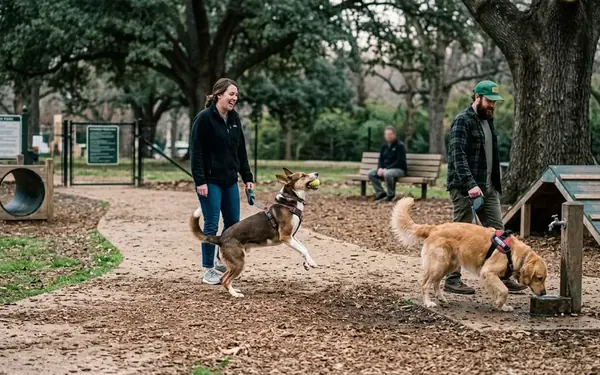
The collar slips over the dog’s head. A squirrel breaks from the grass, the dog launches after it, and the owner panics while reaching for a leash that is no longer attached to anything.
At that moment, the recall cue is competing with movement, scent, distance, and a behavior sequence shaped by biology. In regional comparisons, a healthy 40-pound dog pursuing a moving target can cover 50 yards of open ground in under 5 seconds. Fresh wildlife scent can trigger prey drive and elevate heart rate within somewhere around 0.2 seconds of detection. The handler has almost no time to improvise.
Build a Controlled Distraction Ladder

This is why I start a recall plan with a trigger audit rather than a cue. A sighthound may lock onto the visual acceleration of a rabbit. A scenthound may follow an odor trail even after the animal disappears. The primary training environment should reflect the dog’s strongest sensory pathway.
Reliable recall is not a natural default. It is an engineered response with a reinforcement history strong enough to interrupt another behavior already in motion. Assuming a dog that recalls in a sterile, fenced backyard will respond identically on a nature trail with fresh deer scent ignores the central problem: the environment has changed the value of every available choice.
Critical Insight: Audit what captures the dog first: movement, odor, social contact, food, or access to open space. That trigger determines where proofing must eventually occur.
The Behavioral Mechanics of Coming When Called
A recall is a sequence, not a word. The dog detects the cue, disengages from the current target, turns, travels to the handler, and remains close enough for reinforcement or safe restraint. Weakness at any link can look like disobedience even when the dog has learned only part of the chain.
The relevant principles of operant conditioning are straightforward: behavior followed by a valued consequence becomes more likely under similar conditions. The difficult part is identifying what the dog values at that precise moment.
Rank the Competition
Use a three-tier trigger hierarchy instead of labeling every distraction as simply easy or hard:
- Tier one: stationary, familiar stimuli that produce mild orientation without forward movement.
- Tier two: novel scents, moving people, or visible dogs that hold attention but remain manageable at a distance.
- Tier three: fleeing prey, active play, or fresh wildlife odor that initiates pursuit or sustained tracking.
A dry biscuit rarely competes with fleeing prey. High-value environmental reinforcers require a handler reward with comparable biological relevance, typically moisture-rich proteins such as tripe or liver. Deliver that reinforcement within 2 seconds of the dog reaching you so the consequence attaches to completion of the recall loop, not to sniffing the ground afterward.
Reward selection is only half the equation. Access to the environment can reinforce behavior too. If ignoring the cue allows another chase, the dog has rehearsed nonresponse and received a powerful reward for it.
Foundational Conditioning in Low-Distraction Environments
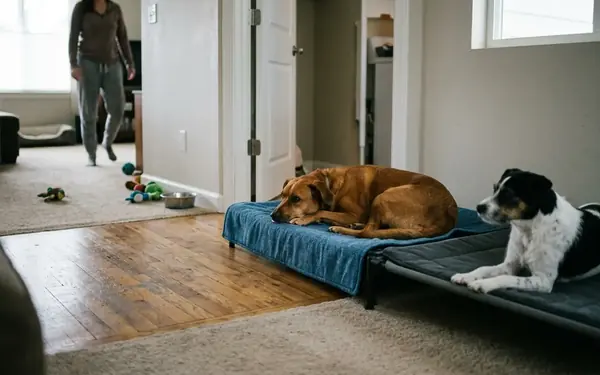
Begin in a quiet indoor corridor measuring 10 to 15 feet. “Sterile” means behaviorally controlled, not clinically empty: remove toys, chews, food bowls, open doorways, and other choices that compete with orientation to the handler.
Foundational Recall Environment Setup
- Clear a 10-to-15-foot hallway of toys, chews, and food bowls.
- Close adjoining doors to eliminate visual drift and restrict spatial choices.
- Prepare 15 pea-sized pieces of high-value, moisture-rich protein.
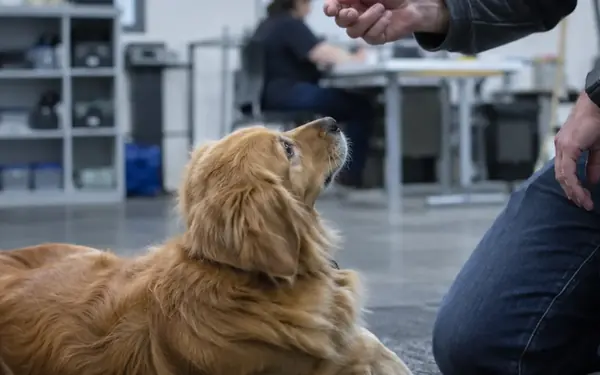
The first learning process is classical conditioning. Say the dog’s name or introductory marker, then deliver food when the dog orients. At this stage, the sound predicts something valuable. Do not test it by calling while the dog is absorbed elsewhere.
Next, shape the operant response. Move a short distance away, give the recall cue once, and mark the first committed movement toward you. Deliver the reward at your legs. Feeding close matters because tossing food away can reinforce stopping short or immediately leaving the handler.
Use Latency as the Advancement Test
Do not advance because the exercise looks smooth for a few repetitions. Track response latency: the interval between the marker sound and the dog turning its head toward you. The criterion for progression is a turn within 0.5 to 1.2 seconds on 8 out of 10 consecutive trials.
Record each trial as a response, delayed response, or nonresponse. That small log separates cue reliability from optimism. If latency stretches, reduce distance, improve the reward, or remove a competing stimulus before repeating the cue.
Recommendation: Keep reinforcement continuous during initial conditioning. A variable schedule belongs later, after the baseline response remains stable around known distractions.
The Long-Line Transition Phase
The move outdoors creates a management problem. The dog needs enough freedom to make a choice, but not enough freedom to reach wildlife, traffic, or another dog after ignoring the cue. A 15-to-30-foot long line closes that gap.
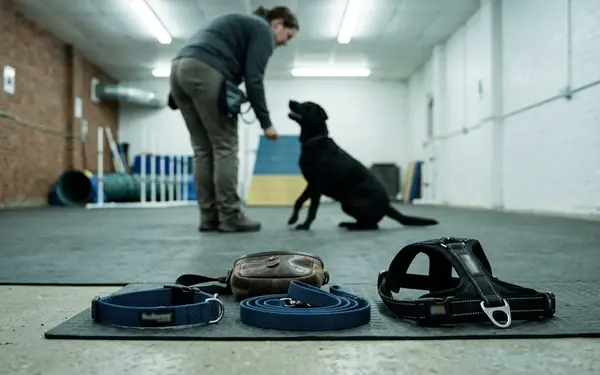
Choose a 1/2-inch biothane line. Depending on its brass hardware, a line in this range weighs approximately 0.5 to 0.8 pounds. Biothane also avoids a practical problem encountered with standard nylon tracking lines: nylon absorbs ground moisture, becomes heavier, and can produce friction burns when it slides quickly through the hand.
Handle Slack Without Creating Pressure
- Attach the line to a well-fitted harness rather than using it to jerk the neck.
- Gather excess line in broad loops while keeping it clear of fingers and ankles.
- Maintain 2 to 3 feet of slack as the dog explores.
- Give the recall cue once, then move backward to create an inviting travel path.
- Use the line to prevent escape only if necessary; do not reel the dog toward you.
Constant tension can trigger the opposition reflex, causing the dog to lean away from pressure. The line should function as a safety boundary, not as the mechanism that completes the recall.
Risk Factor: Certified trainers on our team use long lines extensively for controlled safety work, but careful handling remains essential to prevent friction burns. In a public multi-use park, a 30-foot line requires at least 40 feet of clearance from cyclists and joggers to avoid a severe tripping hazard. A long line is management equipment, not a permanent substitute for off-leash reliability.
Systematic Proofing Against Environmental Distractions
Proofing asks whether the trained response survives a measured increase in competition. Change only one dimension at a time: distraction intensity, proximity, or duration. Increasing all three at once makes a failed response difficult to diagnose.

- Start 20 feet from a low-level, stationary distraction.
- Present the distraction laterally rather than head-on to reduce spatial pressure.
- Cue the recall once and reward at the handler’s legs.
- Repeat within a 10-minute session while monitoring turn latency and line tension.
- Decrease the distance by 2-foot increments over successive sessions only when the preceding setup remains stable.
Decoy dogs should begin calm and side-on, with enough separation that the learner can notice them without surging forward. Novel scents can be placed in a defined area so the handler controls both their location and the dog’s approach. These setups produce cleaner information than waiting for an uncontrolled encounter on a busy trail.
Use the Environment as Payment
The Premack Principle allows a high-probability behavior to reinforce a lower-probability one. If chasing a ball carries more value than returning, call the dog away, reward the arrival, and then release the dog to chase the ball. Access to the preferred activity becomes contingent on recall.
This is also where reinforcement schedules become more technical. Continuous food reinforcement remains appropriate near a strong trigger or when arousal rises. A variable schedule can maintain an established response around familiar, low-level distractions. Adjust the schedule according to baseline arousal and the proximity of the specific trigger, not according to a calendar.
Troubleshooting the Poisoned Cue Phenomenon
A poisoned cue has acquired an unwanted prediction. The dog hears “come” and expects the leash to snap on, play to end, bath time to begin, or punishment to follow. The word may still produce a glance, but it no longer controls a prompt return.
Repeating the cue makes the problem worse. “Come, come, come” teaches that the first sound carries no consequence and that responding remains optional until a later repetition. Stimulus control becomes diffuse because the dog cannot identify which version matters.
When the association is deeply established, retire the old word rather than trying to argue with its history. Select a sharp, two-syllable emergency cue with hard consonants. It should be distinct from everyday conversation and reserved for recall.
Condition the Replacement Cue
- Stand near the dog in a distraction-free room.
- Say the new cue once in a clear, consistent tone.
- Immediately deliver a jackpot of 5 to 7 pieces of high-value protein.
- Feed the pieces sequentially across 8 to 10 seconds so remaining with you becomes part of the outcome.
- End without adding restraint, grooming, or another unpleasant event.
During early pairings, do not use the new word to test distance or interrupt play. First build the prediction. Movement toward the handler can be added once the cue itself produces rapid orientation.
Critical Insight: Protect an emergency cue from routine use. If every park departure begins with that word, the new cue will inherit the same negative forecast as the retired one.
Initiating Your Recall Protocol
Secure a 15-foot biothane long line and a pouch containing high-value, aromatic protein treats. For the first assignment, use a distraction-free hallway and close every adjoining door.
Cap the session at 3 to 4 minutes and conduct exactly five repetitions. Begin close enough that the dog can succeed: give the cue once, move backward, mark the committed turn, and feed at your legs within the reinforcement window. Reset calmly between repetitions without drilling the cue.
Keep the fifth setup easier than the preceding trials. A short, successful final repetition preserves anticipation and avoids satiation.
Run those five hallway recalls today, record the dog’s turn latency after each cue, and stop immediately after the successful fifth arrival.