Potty training a Golden Retriever puppy looks chaotic in the first week and almost boring by the fourth. That predictability is the whole point. This case study follows a single puppy from the day she left the breeder at eight weeks and two days old, and it treats house training the way a behavior workup treats any other problem: measure the baseline, design the intervention, log the response, and adjust when the biology pushes back.
What follows is a working record, not a tidy theory. The numbers come straight from the wall calendar.
The Origin of the Habit: Early Environmental Conditioning
House training does not begin in the new home. It begins in the whelping box. During the critical developmental window of the first eight weeks, a puppy forms substrate preferences—the textures she associates with the act of eliminating. A puppy raised on newspaper learns paper. One raised on pine shavings learns shavings. Those preferences travel with her.
This particular Golden Retriever spent her first weeks in a 6-foot by 6-foot litter enclosure shared with her siblings, on a bed of pine shavings. Then, overnight, she landed in a 1,200-square-foot home with hardwood, tile, and soft rugs. That is a staggering jump in scale for a brain wired to eliminate near the edge of a small, shared space.
The bridge chosen here was literal. A small tray of pine shavings—the exact substrate from the breeder's box—went into the designated corner of the outdoor yard for the first five days. The familiar smell and feel gave the puppy a recognizable target while everything else in her world was new.
Analyzing the Baseline: The First 72 Hours
You cannot fix what you have not counted. The first accidents were not failures to correct; they were data.
Six indoor accidents landed within the first 48 hours. Watching where and when they happened revealed the pattern faster than any general advice could. She actively sought out soft, absorbent surfaces that echoed her breeder bedding—the textured area rugs in the living room drew her like a magnet. Those rugs got rolled up and stored within the first three days, removing the temptation entirely.
The physiology set the ceiling. An eight-week-old puppy simply cannot hold much. Maximum active bladder retention here topped out at 45 minutes before an accident occurred. If you want the mechanics of why a young bladder behaves this way, the neurological development of canine bladder control explains the immature signaling well. Forty-five minutes is not stubbornness. It is anatomy.
Reading the Transition Zones
Accidents clustered at thresholds—the doorway between kitchen tile and living room carpet, the lip where hardwood met the entry mat. Transition areas confuse a young puppy's spatial map. Marking those zones on paper made the triggers obvious and, more importantly, predictable.
Designing the 4-Week Intervention Protocol
The first draft of the schedule failed, and it is worth saying why. A rigid two-hour alarm for outdoor trips seemed sensible on paper. By day four it was abandoned—the alarm kept dragging the puppy out of deep sleep cycles, which does a growing dog no favors and manufactured accidents rather than preventing them.
The pivot was to an event-based schedule. Instead of the clock deciding, the puppy's own behavior did. Outdoor trips happened within 3 to 5 minutes of finishing a meal or waking from a nap. Predictability came from linking elimination to events she generated herself.
Event-Based Potty Training Transition Schedule| Trigger Event | Action Required | Maximum Wait Time |
|---|---|---|
| Waking up (morning or nap) | Immediate trip to designated outdoor spot | 3 minutes |
| Finishing a meal | Leash up and take outside | 5 to 10 minutes |
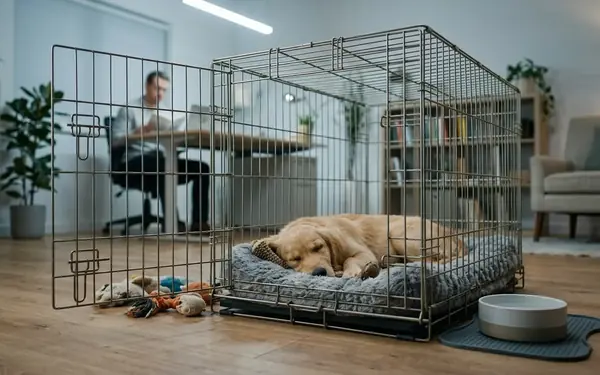
Crate training carried the unsupervised gaps. A 30-inch wire crate with a divider panel restricted her sleeping space to just enough room to stand and turn around. Dogs resist soiling where they sleep, so a right-sized crate borrows that instinct as a management tool. Too much space and the divider becomes pointless—she would simply eliminate in one corner and sleep in the other.
Skip the Clock, Watch the Dog
Event-based timing beat the rigid alarm because it respected the puppy's sleep and fed off signals she already produced. Tie the trip to the meal and the nap, not the hour.
Implementing Operant Conditioning for Elimination
Here the theory earns its keep. Operant conditioning reinforces a behavior by pairing it with a consequence the animal values, delivered close enough in time that the connection is unmistakable. For elimination, the desired behavior is going outdoors, and the reinforcer is high-value food arriving within a heartbeat of the act.
A sharp verbal marker—a clear "Yes!"—did the work of a clicker. The choice was practical. Juggling a leash, a flashlight, and a treat pouch during a 2:00 AM outing left no free hand for mechanical timing. The voice is always available.
Reward delivery ran tight. A single piece of freeze-dried beef liver arrived within 2 seconds, give or take, of the puppy finishing. Wait longer and you risk rewarding whatever she did next—sniffing, turning, walking away—instead of the elimination itself. Each outdoor trip carried a strict 3-minute limit; if nothing happened, she went back to the crate and tried again shortly after, rather than wandering the yard learning that outside means playtime.
Scolding a puppy for an indoor accident often teaches her to hide behind furniture to eliminate, rather than teaching her to hold it. Punishment suppresses the behavior in your presence; it does not build bladder control.
Troubleshooting Regressions and Biological Limits
Week three brought the setback that nearly every case does. Three accidents appeared within four feet of the back door—close enough to signal intent, short of the goal. A regression at this stage rarely means the protocol is broken. It usually means something in the routine shifted.
The culprit was timing around water. Heavy panting after evening play meant she was drinking more, later. Moving the evening water bowl removal from 7:00 PM to 8:00 PM kept her comfortable, and a temporary 1:30 AM outdoor trip absorbed the extra fluid. No scolding, no drama—just an adjustment to the schedule that matched her body.
Growth helped. She climbed from 12 pounds to 18 pounds across the study, and bladder capacity expanded naturally alongside her frame.
The Four-Week Number Has an Asterisk
This timeline leans hard on the physiology of a large breed. A Golden Retriever's bladder develops on a generous curve. Toy breeds carry far smaller capacities and often need 12 to 16 weeks to reach comparable reliability. Judge progress against your dog's size, not a calendar borrowed from someone else's puppy.
Living situation changes the mechanics too. High-rise apartment dwellers without immediate yard access often substitute a balcony grass patch for the outdoor trip, since a young puppy cannot survive an elevator ride inside the 3-minute post-nap window.
Quantitative Results and Behavioral Shifts
A physical wall calendar tracked everything—red markers for accidents, green for successes. That simple tool kept a rough day from coloring the overall read; frustration on a Tuesday could not erase a green-heavy week.
The trend was unambiguous. From day 22 through day 28, the calendar showed zero indoor accidents. Six accidents in the first 48 hours had collapsed to a clean final week.
More telling than the absence of accidents was the arrival of communication. Independent pacing appeared 4 to 6 feet from the patio door, lasting 15 to 30 seconds before she would vocalize. She had learned that the door meant relief, and she began asking for it. Consistency built that link: the same trigger, the same trip, the same reward, repeated until the sequence became her own idea.
The Final Milestone: A Morning Routine Realized
Day 28. Wake time had settled at 6:15 AM, steady as a metronome.
The crate door opened, and instead of being scooped up and carried—the trick used in weeks one and two to prevent mid-transit puddles—she walked. All fifteen feet from the bedroom crate to the glass patio door, past the spot where the rugs used to be, without stopping to sniff or squat.
Then she sat. Quiet, tail sweeping the floor, nose an inch from the glass, waiting for the leash. Out through the door, straight to the pine-scented corner of the yard, and done in under a minute. The liver came within two seconds, right on cue.
She trotted back inside already looking for breakfast, the whole exchange so ordinary it hardly seemed worth marking on the calendar. Green pen, day 28.