Loose leash walking looks simple from the sidewalk: dog near handler, leash relaxed, both moving in the same direction. In practice, it is a behavior built from pace control, pressure response, reinforcement timing, and emotional regulation. When one layer slips, pulling often returns before the handler realizes the criteria changed.
I treat pulling as information first, not defiance. The leash tells us when the dog has lost the reinforcement zone, when the environment has become too valuable, or when the handler has started rewarding forward pressure without meaning to.
What's Inside
- The Behavioral Mechanics of Leash Pulling
- Equipment Analysis: Tools for Behavioral Management
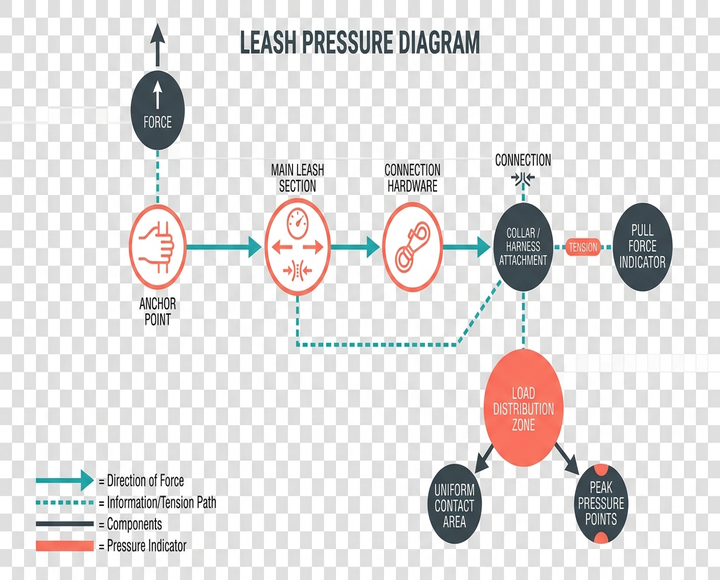
- Understanding Leash Pressure and Operant Conditioning
- Step-by-Step Loose Leash Implementation
- Troubleshooting High-Distraction Environments
- Scope and Limitations of Behavioral Modification
The Behavioral Mechanics of Leash Pulling
Opposition reflex starts before the leash goes tight
The canine opposition reflex is the tendency to push or brace against pressure. If the collar or harness tightens and the dog feels restraint, many dogs lean harder into that sensation. The handler feels pulling. The dog feels a barrier and drives through it.
During leash assessments, trainers usually watch the moment the dog's center of gravity shifts forward before tension appears. That is the useful threshold. Waiting until the leash is fully taut means the handler is already late.
Critical Insight: The cleanest intervention point is not the snap of the leash tightening. It is the half-second when the dog's shoulders move ahead of the reinforcement zone and the leash is about to lose its curve.
Pace mismatch creates the first mechanical problem
Dogs naturally move faster than most people. Canine natural walking pace often sits around 3.5 to 4.5 miles per hour, give or take, while human walking pace typically falls between 2.5 and 3 miles per hour. That difference matters.
A young Labrador in a quiet neighborhood may not be trying to drag anyone. He may simply be walking at his default rhythm. If the handler rewards that rhythm by following, the dog learns that pressure predicts access.
Environmental reinforcement finishes the loop. The dog pulls toward a hydrant, reaches the hydrant, sniffs, and the pulling behavior gets paid. No treat pouch was involved, but reinforcement happened anyway.
Equipment Analysis: Tools for Behavioral Management
Front-clip harnesses change the pivot point
Equipment does not train the dog by itself. It changes the physics available to the handler.
A front-clip harness redirects force across the chest and can encourage the dog's shoulders to pivot back toward the person. A traditional flat collar concentrates pressure around the neck and, for some dogs, increases bracing. During equipment selection, handlers should evaluate the dog's pivot response under light pressure. If the shoulders do not naturally redirect toward the handler, the harness fit needs adjustment at the chest and shoulder line before the training plan can be judged.
Retractable leashes blur the criteria
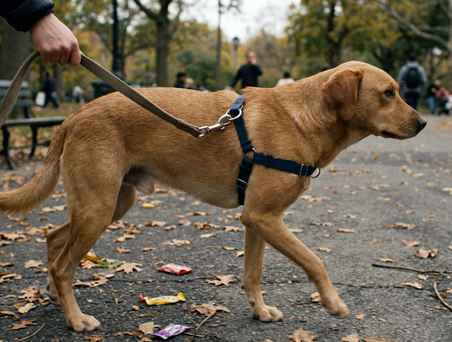
Retractable leashes teach variable distance. The dog may feel tension and still move forward, then feel less tension after the mechanism releases more line. That pattern makes loose leash criteria hard to define.
For teaching, based on participant logs, a standard 6-foot leash gives cleaner feedback. Standard 6-foot leashes made of 5/8-inch to 3/4-inch biothane or leather provide clear tactile communication for most handlers because the leash transmits small changes without excessive bounce. Nylon can work, but sudden 10- to 15-pound tension spikes may cause friction burns if the line slides through the hand.
Recommendation: Use one fixed-length leash during foundation training. Change the environment before changing the leash length.
Understanding Leash Pressure and Operant Conditioning
Yielding to pressure is a taught response
Many dogs do not automatically understand that light leash pressure means, "move toward me." They may freeze, pull harder, jump, bite the leash, or scan the environment. Yielding to pressure should be trained like any other cue: low intensity, immediate release, clear reinforcement.
The handler applies the lightest useful pressure, waits for the dog to soften or step toward the handler, then releases. The release tells the dog which movement worked. The food reward builds value for choosing that movement again.
Here is the one method I no longer keep in a foundation plan: continuous luring with high-value treats held at the hip. It can produce a pretty-looking walk for a few minutes, but it often creates bribe-dependent behavior. The dog follows the visible food, not the leash criteria. The better sequence is mark the leash slackening, then deliver the reward where you want the dog to be.
The J-shaped leash position needs precise timing
The visual target is simple: a relaxed 'J-shape' between the handler's hand and the dog's equipment. The timing is less forgiving. Reward delivery must occur more or less 0.5 to 1 second after the leash slackens to pair the release of pressure with reinforcement.
This is where research on positive reinforcement training methods aligns with what careful leash work requires: mark the desired behavior, reinforce promptly, and keep the dog below the point where learning collapses into reaction.
Step-by-Step Loose Leash Implementation
Step 1: Establish the reinforcement zone
Start smaller than most owners want to start. Initial reinforcement zones are often somewhere around 10 feet by 10 feet in low-distraction areas, such as a hallway or empty garage. That limited space removes the false question of distance and lets the dog learn position.
- Stand still with the dog on the leash.
- Mark and reward when the dog is near your chosen side, with the leash slack.
- Take one step. If the dog stays inside the zone, mark and reward.
- Add two or three steps only when the dog can stay oriented without a visible lure.
Foundational practice works best in 3- to 5-minute sessions before moving outdoors. Short sessions reduce handler sloppiness and keep the reward rate high enough for the dog to understand the pattern.
Step 2: Use the Tree Method
The Tree Method means forward movement stops the moment tension occurs. Not two steps later. Not after the dog reaches the mailbox. The handler becomes still, waits for slack, marks the slackening, then continues.
When mapping this progression, keep the Tree Method in environments with a distraction radius of at least something like 50 feet. The goal is not to test whether the dog can resist a squirrel at close range. It is to teach that tension turns off forward access.
Step 3: Add directional changes
Directional changes reset attention without turning the walk into a wrestling match. Say the dog's name once, turn, and move the other way with purpose. Reward when the dog catches up inside the reinforcement zone.
This is especially useful for dogs developing a 'yo-yo' pattern where they intentionally pull to the end of the leash just to return for a treat. In that case, reinforce sustained position, not the dramatic return. A dog who holds the zone for several steps should earn more than a dog who slingshots back after creating tension.
Troubleshooting High-Distraction Environments
Lunging changes the safety calculation
Wildlife, other dogs, skateboards, and fast-moving children can push a dog past the point where ordinary leash mechanics matter. At that moment, the handler's job is distance and recovery, not obedience polish.
To manage sudden lunging, evaluate recovery latency. If the dog takes longer than 15 seconds, more or less, to re-engage eye contact after a trigger passes, increase distance immediately in the next repetition. That delay tells you the dog was not just distracted; the dog was over threshold.
Risk Factor: The Tree Method becomes physically unsafe and counterproductive if the dog exceeds about a third of the handler's body weight and is actively lunging at a moving trigger.
Reset the walk before frustration drives corrections
Leash corrections often feel efficient because they interrupt behavior quickly. They also risk adding pain, surprise, or frustration to a trigger the dog already finds exciting or threatening. That trade-off rarely helps long-term leash reliability.
A standard reset uses a 180-degree directional change followed by 4 to 6 rapid backward steps to trigger the dog's natural chase instinct toward the handler. Keep your voice light. Reward the dog when he reorients, then leave the hot zone before asking for precision again.
Loose Leash Troubleshooting Matrix| Observed Behavior | Immediate Handler Action | Next Session Adjustment |
|---|---|---|
| Dog forges ahead but leash remains loose | Maintain pace and reinforce position at the hip | No change required; monitor for tension |
| Dog hits the end of the leash toward a trigger | Stop forward access if safe, then create distance | Begin farther away and lower the distraction level |
| Dog cannot re-engage after the trigger passes | Use a 180-degree reset and leave the area | Increase distance if recovery exceeds that same 15-second mark |
| Dog yo-yos out and back for treats | Reward sustained position instead of the return only | Adjust the reinforcement rate before hard distractions |
One practical example: adjusting the reinforcement rate from every 3 steps in a quiet cul-de-sac to every single step when passing a dog park is not backsliding. It is matching the pay schedule to the environment.
Scope and Limitations of Behavioral Modification
Loose leash walking takes repetition, not a single breakthrough
Based on participant feedback, establishing a reliable loose leash walk in a moderately distracting neighborhood often takes 8 to 14 weeks of daily 15-minute foundational sessions. That range assumes the handler practices criteria consistently and keeps the dog under threshold often enough for learning to accumulate.
The conclusion is most dependable when the dog is physically comfortable, the equipment fits correctly, and the handler records threshold changes rather than relying on memory. A dog who pulls less in week three may still pull hard near a school pickup line, and that does not erase progress.
Some dogs need more than leash drills
High-drive working breeds may need structured outlets before walking practice: scent work, controlled tug, decompression time, or breed-appropriate tasks. Without that outlet, the walk becomes the only place the dog can spend energy. The leash then carries too much behavioral weight.
Severe reactivity belongs in a different category. Behavioral consultants often track the frequency of over-threshold events and look for sustained hyperarousal after triggers. If the dog cannot recover, cannot take food, redirects onto the handler, or escalates around predictable neighborhood stimuli, seek a certified veterinary behaviorist.
Loose leash walking is not about making the dog smaller. It is about teaching the dog how to move through a human-paced world without constant conflict at the end of the line.