Puppy nipping arrives fast and stings enough to make owners doubt their training instincts. The teeth are needle-thin, the mouth finds every wrist and ankle, and well-meaning advice contradicts itself at every corner. Before reaching for a fix, it helps to understand what the behavior actually is: a developmental process with a biological schedule, not a temperament flaw.
Mouthing can be handled as a system, stage by stage, from its evolutionary origin to the length of a corrective pause.
The Ancestral Roots of Canine Mouthing
A puppy explores the world through its mouth because that is where its most sensitive equipment sits. Primary tactile sensory receptors concentrate in the muzzle and jaw, so mouthing functions as the canine equivalent of a toddler reaching out to touch every surface in a room.
The regulation of that mouth begins in the litter. When behaviorists moved their attention away from isolated puppies and toward observing four-to-six-week-old litters at play, they mapped how sibling interaction calibrates jaw pressure. A puppy bites too hard, a littermate yelps and disengages, and the game stops. This feedback loop typically operates between weeks four and seven of development.
The practical takeaway is uncomfortable but clarifying. Modern puppy nipping is a biological imperative carried over from that ancestral learning environment. A puppy removed from its litter early simply arrives in the human home with an incomplete set of pressure lessons still to finish.
The Physiological Timeline of Puppy Teething
Analyzing the Mechanics of Bite Inhibition
Managing Human Reactions to Nipping
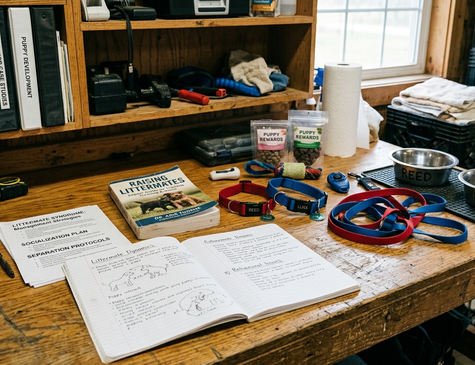
Layered on top of exploration comes physical pain. Between roughly 12 and 24 weeks, a puppy sheds 28 deciduous teeth and grows in 42 adult teeth. Veterinary dentists tracked this eruption sequence to pinpoint the periods of peak inflammation, and the pattern is consistent.
Incisors typically erupt between weeks 12 and 16. Canines and premolars follow between weeks 16 and 24. Together these overlapping eruptions create a distinct 8-to-12-week window of acute gingival inflammation, and inflamed gums drive an intense, near-constant need to chew.
Veterinary consensus holds that this physiological discomfort amplifies mouthing during that developmental window. The puppy is not misbehaving more; its gums simply hurt, and pressure against a firm surface offers relief.
Chew Progression at a Glance
| Age Range | Dental Stage | Recommended Toy Texture |
|---|---|---|
| 8 to 12 weeks | Deciduous teeth fully present | Soft plush, pliable rubber |
| 12 to 16 weeks | Incisors erupting, high inflammation | Frozen washcloths, chilled soft rubber |
| 16 to 20 weeks | Canines and premolars emerging | Medium-density rubber |
| 20+ weeks | Adult premolars setting | Dense, harder rubber |
Acquired bite inhibition is the learned skill of controlling jaw pressure, and it protects everyone the adult dog will ever meet. A dog that startles, gets stepped on, or feels cornered may still open its mouth; whether that moment ends in a bruise or a hospital visit depends on lessons learned during puppyhood. The University of Illinois College of Veterinary Medicine offers a useful primer on acquired bite inhibition for owners who want the clinical grounding.
Early attempts to shut down all mouthing immediately taught trainers a hard lesson. Dogs raised that way often developed poor jaw control as adults, because they never practiced calibrating pressure at all. The protocol was revised: reduce bite force first, then reduce bite frequency.
The sequencing matters. A standard bite inhibition protocol requires somewhere around 21 to 28 days of consistent pressure feedback before a measurable reduction in bite force appears. Puppies learn thresholds the same way littermates taught them, through feedback that follows the pressure. Rush the frequency before the force is soft, and you skip the step that keeps the adult dog safe.
These figures describe typical developmental windows observed across teething puppies; an individual's eruption schedule and learning pace shift the exact dates by a week or two in either direction.
Differentiating Teething from Overstimulation
Not every evening nipping storm comes from sore gums. A large share traces to exhaustion. Growing puppies require somewhere around 18 to 20 hours of sleep per 24-hour cycle, and when they fall short, their behavior deteriorates in a recognizable way.
Handlers who logged evening activity found a distinct shift: slow, methodical chewing gives way to rapid, frantic snapping that tracks closely with sleep deprivation. This is the fatigue-driven witching hour, and it typically lands between 5:00 PM and 8:00 PM, when the day's cumulative stimulation peaks and the puppy has run out of the capacity to settle itself.
Reading the two states apart changes your response. Acute dental discomfort calls for a cold chew; overstimulation calls for enforced rest, often in a crate or a quiet pen, because the puppy cannot choose sleep on its own.
Where Redirection Stops Applying
One catch worth stating plainly. Every technique here addresses developmental teething and overstimulation. It does not address resource guarding, nor the stiff-bodied, fear-based aggression that presents differently and requires immediate professional behavioral intervention. If a puppy freezes over a food bowl or bites from a place of fear rather than play, redirection is the wrong tool, and a qualified behaviorist is the right call.
Strategic Redirection and Chew Toy Implementation
Redirection works because it answers the puppy's actual need instead of merely blocking the behavior. The mouth wants something to press against, so give it a legitimate target the instant it reaches for skin.
- Notice the approach before the nip lands, watching for the head lowering toward a hand or ankle.
- Hold still rather than jerking away, since sudden motion reads as prey.
- Present an appropriate chew directly into the path of the mouth.
- Praise quietly the moment the puppy commits to the toy instead of the skin.
- Repeat without frustration, treating each interception as one rep in a long set.
Matching Texture to the Tooth
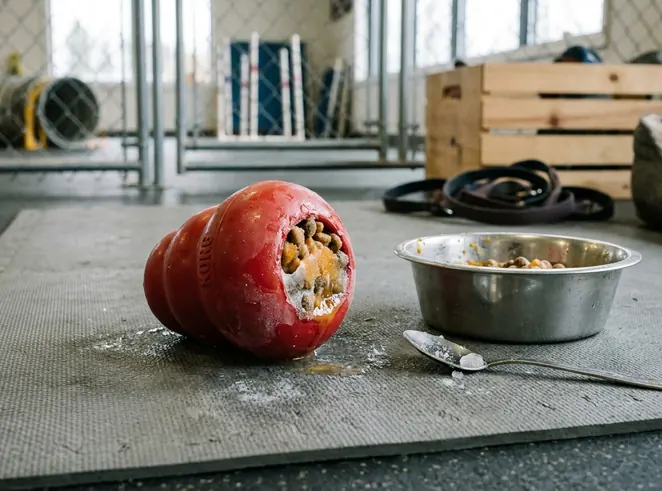
Behaviorists sort chew toys by durometer, the measure of hardness, so that resistance matches the stage of teething without risking dental fractures. Soft, flexible rubber or a frozen damp washcloth suits weeks 12 to 16, when incisors erupt and inflammation runs high. The transition to harder, dense rubber should wait until after week 20, once the adult premolars begin setting into the jaw.
Cold does real work here. A frozen washcloth or chilled toy numbs inflamed gums, and its value shifts with the calendar: it delivers immense relief during incisor eruption, yet a puppy in the later premolar stage may ignore it entirely while seeking harder resistance instead.
Keep on Hand This Week
Stock two or three chews at the texture matching your puppy's current week, plus a damp washcloth folded in the freezer. Rotate them so the cold one is always ready when the witching hour hits.
The most repeated piece of advice may be the one that fails most often. Owners are told to yelp in a high pitch to mimic a littermate, but analysis of video footage showed that this high-pitched sound frequently triggers a predatory chase sequence. The yelp raises the puppy's arousal, and the biting escalates rather than stopping.
The silent alternative reverses the logic. In a reverse time-out, the human leaves the game. Step over a baby gate or walk out of the room for 10 to 15 seconds, give or take. That window is long enough to register as a loss of attention and short enough that the puppy connects the withdrawal directly to the bite that caused it. Biting ends the fun, cleanly and without drama.
Consistency across the household decides whether the lesson holds. If one person enforces the reverse time-out and another lets sharp teeth slide because the puppy looks adorable doing it, the puppy learns that the rule is negotiable. Emotional regulation on the human side is part of the protocol, not an accessory to it.
Evaluating Your Training Approach
Progress is measurable if you track it. Coordinators who set up weekly logging systems asked owners to record the frequency of hard nips against soft mouths, which turns a frustrating stretch into a readable trend line.
Drawing on those owner logs, consistent reverse time-outs paired with redirection typically produce a noticeable softening of bite pressure within 14 to 21 days. Bite inhibition remains a learned skill built over weeks of repetition, and occasional regressions should be expected until around month six, when the adult teeth finish setting in the jaw. Patience is not passive here; it is the mechanism.
So when the next set of needle teeth closes on your wrist tonight, will you raise your voice and feed the chase, or step over the gate and count to fifteen?