Relocating with a dog is rarely a matter of simply moving belongings from one address to another. For families arriving in Shelby County, the transition layers a demanding regional climate on top of the behavioral disruption that any geographic move imposes on a companion animal. Planning for that move means accounting for local environmental, legal, and behavioral pressures, with help from local veterinary patterns and established transition protocols, so owners can plan deliberately rather than react after problems surface.
Shelby County Conditions for Pet Owners
The Mid-South climate is the first variable a relocating owner should account for, and the relevant figure is not temperature alone. From multi-year tracking, summer heat indices in Memphis frequently sit in the 105-to-112-degree Fahrenheit range during July and August. Yet local veterinary feedback consistently points to moisture, not ambient heat, as the dominant stressor on canine comfort and respiration.
Average morning humidity hovers between 70 and 90 percent from late spring through early autumn. A dog cools itself primarily through panting, a mechanism that loses efficiency as humidity climbs. The practical consequence is that something like a 95-degree morning in a dry climate and the same reading in Shelby County are not the same physiological event for a panting animal.
Urban Memphis Versus the Suburban Periphery

The county is not a single environment. Urban Memphis presents dense pavement, traffic noise, and limited green corridors, while suburban municipalities such as Germantown and Collierville offer larger lots, quieter streets, and more accessible trail systems. Each profile carries its own set of stressors.
A dog moving into a downtown apartment must adapt to acoustic overstimulation. A dog moving into a suburban backyard faces a different and frequently underestimated risk: an unfamiliar perimeter. Dogs escaping poorly secured fences in unfamiliar suburban backyards during the first week of relocation is one of the most common preventable incidents owners report, and it stems almost entirely from misplaced confidence in a fence the animal has not yet learned to respect.
Legal and Veterinary Framework in the Mid-South
Compliance in Shelby County begins with rabies vaccination. The county mandates that rabies tags be worn at all times and renewed either annually or tri-annually, depending on the specific vaccine administered. Owners arriving from jurisdictions with different schedules should confirm their dog's status against the local requirement rather than assume reciprocity. Current details are published through the Shelby County Health Department rabies regulations.
The regional disease profile deserves equal attention. Among the threats endemic to the Mississippi River Valley, heartworm disease ranks first, a prioritization driven by the dense mosquito populations the local river ecology sustains. Transmission risk remains active year-round in the Mid-South, with peak infection windows running from April through October.
This year-round exposure changes the calculus for owners accustomed to seasonal preventatives. A dog that paused heartworm medication during a northern winter should resume immediately on arrival.
Recommendation: Transfer veterinary records and establish a local care provider before the boxes are unpacked, not after the first emergency. A new clinic that already holds a dog's vaccination history and heartworm status can act far faster when it matters.
Behavioral Impact of Relocation
Dogs read territory and routine as fixed structures. A relocation dismantles both simultaneously, and the animal has no narrative to explain why. The physiological signature of that disruption is measurable: canine cortisol levels typically need something like 7 to 14 days to normalize following a major geographic relocation. During that window, behavior that looks like defiance is more accurately read as dysregulation.
Active and Passive Stress Markers
Anxiety markers fall into two categories, and owners tend to notice only one. Active signs are loud and obvious: destructive chewing, persistent vocalization, and regression in house training. Destructive chewing most commonly targets exit points such as door frames and window sills during the initial transition phase, a pattern that reflects the dog's preoccupation with the boundary between the unfamiliar interior and the lost outside world.
Passive signs are quieter and easier to dismiss. Lethargy, withdrawal, and reduced appetite are frequently misread as ordinary fatigue from travel. They are not. Silent stress is still stress, and a dog that retreats and stops engaging warrants the same attention as one that chews through a baseboard.
One more correlation deserves emphasis. Owner stress during a move does not stay contained to the owner. Dogs mirror the emotional state of the household, and a frantic, sleep-deprived family transmits that state to an animal already searching for cues about whether the new environment is safe.
Step-by-Step Transition Plan
A structured transition reduces the cortisol recovery window and prevents the most common acute incidents. The work begins well before moving day.
- Desensitize to packing materials. Begin introducing moving boxes and packing activity somewhere around 14 to 21 days prior to the actual moving date. Letting boxes accumulate gradually, paired with normal feeding and play, prevents the dog from associating the sudden appearance of cardboard with an impending upheaval.
- Prioritize secure transport. On moving day, secure containment and climate control take precedence over the dog's comfort preferences. A crated dog in a temperature-regulated vehicle is safer than a loose dog with a view, particularly given regional heat.
- Restrict access on arrival. Confine the dog to a single, dog-proofed safe room for the first 48 to 72 hours, give or take. An early version of this guidance recommended giving dogs immediate run of the new home to satisfy curiosity. That approach was abandoned after it reliably produced pacing and overstimulation rather than confidence. A bounded space the dog can master first, then expand outward from, consistently settles the animal faster.

From the safe room, access expands one zone at a time as the dog demonstrates calm. The room becomes a reliable retreat the dog returns to, which is precisely the point.
Scope and Limitations of Behavioral Interventions
These protocols carry an honest boundary. They assume a dog with a baseline of secure attachment. A dog with a documented history of clinical separation anxiety will likely require pharmacological support alongside behavioral modification, and no amount of careful safe-room sequencing substitutes for that.
Timelines vary more than owners expect. Based on participant feedback, acclimatization ranges from roughly 3 weeks for a confident adult dog to upwards of 3 months for a senior dog or a recent rescue. The contrast between a high-drive herding breed and a senior companion dog illustrates the spread: the same house, the same routine, and two entirely different adjustment curves.
Critical Insight: The threshold for professional escalation is physical danger, not duration. Self-mutilation or a hunger strike lasting longer than 48 hours requires immediate veterinary intervention rather than continued behavioral modification. At that point the appropriate referral is to a board-certified veterinary behaviorist, not another week of patience.
Recognizing this line protects the dog from prolonged distress and protects the owner from the false belief that effort alone resolves every case.
Integrating into the Local Pet Community
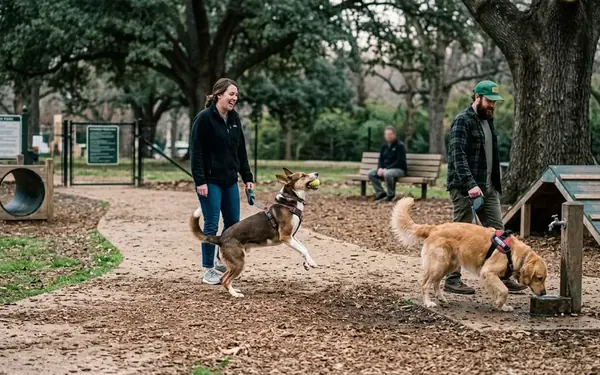
Acclimatization accelerates once the dog begins building positive associations outside the home. Shelby Farms Park anchors that effort, offering an off-leash area encompassing over 100 acres, per park information. Few urban regions provide a green space of that scale, and a confident dog can use it to discharge energy that would otherwise feed indoor anxiety.
Timing matters as much as location. Community integration in Memphis works best in the early morning and late evening, because mid-day outdoor exertion is genuinely unsafe here. Asphalt temperatures can exceed ambient air temperatures by up to 40 degrees, more or less, which means paw protection or an adjusted schedule is not optional during summer.
Risk Factor: A surface that feels warm to a standing adult can scald a dog's pads within seconds. Press the back of your hand to the pavement for five seconds before any walk; if you cannot hold it there comfortably, neither can your dog.
Routine and Support Network
Consistent walking routes through the new neighborhood build the dog's spatial confidence faster than sporadic long outings. The same loop, walked at the same hours, converts an unfamiliar block into known territory.
Establishing a local support network completes the transition. Identifying trusted pet sitters and trainers before they are urgently needed gives the household a fallback and gives the dog a small circle of familiar handlers. Forum feedback from area owners confirms that the families who settle most smoothly are the ones who built these relationships in the first month rather than the first crisis.