A dog reads home through scent and spatial memory long before they read your face. So when the furniture shifts, the boxes appear, and the familiar smell of the hallway gives way to packing tape and strangers' shoes, the animal is not being dramatic. They are losing the map they navigate by.
This guide walks through relocation anxiety from the inside out: the neurology that drives it, the markers that signal trouble early, and a staged protocol that gives most dogs a fighting chance at a calm transition. It also marks the line where environmental management ends and clinical care begins.
The Psychology of Canine Relocation Stress
Dogs are territorial animals, and territory for them is largely an olfactory construct. The canine olfactory bulb processes spatial familiarity directly, which means a change in the ambient odors of a home doesn't merely register as "different" — it stimulates the sympathetic nervous system. The body braces before the conscious mind catches up.
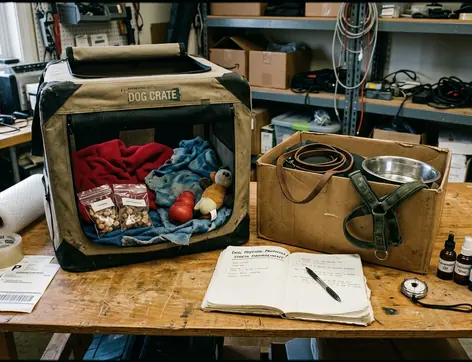
Behavioral consultants often gauge a dog's baseline by watching how they respond to small spatial edits. Move the sofa two feet. Relocate the water bowl. The reaction to these minor disruptions predicts, with reasonable accuracy, how much capacity the dog holds for a full relocation. A dog who sniffs the displaced couch for an hour is telling you something about their threshold.
Here is the part that catches owners off guard. Cortisol levels in dogs experiencing environmental disruption can stay elevated for somewhere around 48 to 72 hours after a single triggering event. So stressors don't reset overnight. They stack.
This is the concept of trigger stacking: the boxes on Monday, the tape gun on Tuesday, the unfamiliar movers on Wednesday, each landing on top of an already-raised cortisol baseline. By moving day, a dog who seemed "fine" all week is operating with almost no buffer left.
Identifying Behavioral and Physiological Stress Markers
Stress rarely announces itself with a bite. It whispers first.
The early physiological signals are quiet and easy to dismiss: lip licking when no food is present, a yawn that has nothing to do with sleep, a tightly closed mouth with the corners — the commissures, pulled back. That last sign, paired with pupil dilation, often precedes vocalization by several minutes. It is a window, and most owners miss it.
Based on participant logs, breathing tells the clearest story. A normal resting respiratory rate sits between 15 and 30 breaths per minute, give or take. Stress panting frequently pushes past 40 breaths per minute, and it does so even in a climate-controlled room where heat is no explanation.
Behavioral shifts arrive next: pacing, repetitive vocalization, and a sudden swing toward either velcro-like attachment or complete withdrawal under furniture. Skilled trainers don't react to a single yawn. They count displacement behaviors across a set window, distinguishing a momentary flinch from a genuine upward trend.
The goal of early recognition is simple. Intervene while the dog is anxious, not after they have tipped into panic. Recovery from the former takes minutes; recovery from the latter can take days.
Pre-Move Preparation and Desensitization
Start earlier than feels necessary. Desensitization protocols call for introducing moving boxes 14 to 21 days, more or less, before the move, which gives the dog time to file "cardboard" under "neutral" rather than "threat."
The first exposure should be almost boring. Place one or two flat, unassembled boxes in neutral areas where the dog already eats or plays. No fanfare. As the dog investigates, pair the appearance of each box with something genuinely high-value — not kibble, but the cheese or chicken reserved for moments that matter. Over days, the box becomes a predictor of good things rather than upheaval.
Don't Pack in Secret
A common instinct is to pack everything while the dog is out at daycare, sparing them the chaos. Behaviorists found this backfires. The dog returns to a home stripped of familiar items, with no gradual warning, and the sudden disappearance triggers a sharper panic than the packing ever would. Let the dog witness the slow, rewarded process instead.
Hold the Routine Steady
Amid the disruption, the dog's core schedule becomes an anchor. Feeding and walking at their usual times signals that the world hasn't entirely come apart. Predictability is the cheapest anti-anxiety tool available, and it costs nothing but discipline.
Risk Factor: The desensitization timeline must be stretched considerably for rescue dogs with a history of multiple rehomings. For these dogs, cardboard boxes may function as a learned predictor of abandonment rather than ordinary environmental change. Go slower, and watch the markers closely.
Moving Day Protocols for Safety and Calm
Moving day is the highest-risk window, both for panic and for escape. Open doors, strangers, and constant noise create exactly the sensory overload a frightened dog will try to flee from.
The answer is a hard boundary. Relocation specialists designate a single locked interior room, mark it with a visible warning sign so movers don't open it, and keep the dog inside throughout the loading phase. This isn't confinement for its own sake — it's a sealed pocket of calm in an otherwise chaotic house.
Setting Up the Safe Zone
Preparation matters more than the room itself. Synthetic appeasing pheromone diffusers need something like 24 hours of continuous operation to reach an effective ambient concentration, so plug them in the day before, not the morning of. A white noise machine should be tuned to mask the low-frequency thuds of furniture being hauled, the sounds that travel through floors and rattle a nervous dog.
Moving Day 'Safe Zone' Setup Checklist
- Select an interior room with minimal foot traffic and secure windows.
- Plug in a synthetic appeasing pheromone diffuser the day before.
- Set up an unwashed crate, bed, and familiar blankets.
- Provide a spill-proof water bowl and a long-lasting chew.
- Post a clear warning sign on the door for movers.
Transport and First Introduction
Transport the dog in their own familiar crate, the one that already smells like them, with a pheromone spray applied beforehand. A word of caution here: assuming a dog who rides well in the car will adapt easily to a permanent new home confuses two very different things. Transit is temporary. Territorial displacement is not, and the dog knows the difference the moment the engine stops.
When you arrive, introduce the new property on leash and slowly. Let the dog set the pace of investigation rather than carrying them across the threshold into a wall of unfamiliar smells. The American Veterinary Medical Association offers practical logistics worth reviewing in its guidelines on moving with pets.
Post-Move Acclimation and Routine Establishment

There's a strong urge to wash everything and let the new house smell fresh and clean. Resist it. Place the dog's unwashed bed and favorite toys in the new living area before the dog arrives. This scent-anchoring drops a familiar olfactory flag into unfamiliar territory, giving the sympathetic nervous system one reassuring data point to hold onto.
One caveat worth naming plainly: this technique leans entirely on the dog's existing positive attachment to that bed. Swapping in a brand-new bed for the move erases the calming effect entirely. Keep the old, smelly, beloved thing.
Rebuild the Schedule First
Confidence in a new environment is built through predictability. Keep feeding times within a strict 15-minute window of the dog's previous schedule. The body learns that even though the walls changed, dinner still comes when it always did, and that single constant does enormous quiet work.
Walk Small Before Walking Far
The new neighborhood is a flood of novel information. For the first 3 to 5 days, restrict walks to a 50- to 100-yard radius from the front door. Short loops, generous reinforcement, frequent returns to the safe home base. Expand the radius only as the dog's body language relaxes, not on a calendar.
Limitations of Behavioral Modification and When to Seek Help
Environmental management resolves a great deal. It does not resolve everything. Dogs with severe separation anxiety or a generalized anxiety disorder may not improve through scent anchoring and routine alone, and pretending otherwise delays the help they need.
Veterinary behaviorists assess efficacy by tracking recovery time — how long it takes a dog to settle after a trigger. When the animal cannot return to baseline within a reasonable post-trigger window, the situation has moved past what management can fix on its own.
Two clinical thresholds deserve particular attention. A dog refusing high-value treats for more than 24 hours after the move is showing a primary indicator for veterinary intervention. Persistent panic that doesn't ease across days is the second.
Critical Insight: Pharmacological support is not a failure of training. Short-acting anxiolytics, often administered in the hour or two before a stressful event, can serve as a temporary bridge through the transition, lowering the dog's baseline enough for behavioral work to actually land.
These protocols help most dogs, and they help meaningfully — but the response to relocation is individual, shaped by genetics, history, and the specific dog in front of you. Treat the timelines here as starting points to adjust, not guarantees to enforce. When the markers keep climbing despite your best work, a certified veterinary behaviorist is the right next call.