Resource guarding gets misread more than almost any behavior I assess in clinic. Owners arrive convinced their dog is being spiteful, dominant, or "protective" in some willful way. The truth is quieter and far more useful: a guarding dog is afraid of losing something it values. That single shift in framing changes everything about how we intervene.
The Evolutionary Context of Resource Guarding
Guarding is not a character flaw. It is a retention mechanism, refined over thousands of years of canine survival. When behavioral researchers built the modern frameworks we use today, they categorized guarding by watching how feral and free-ranging dogs actually behave around food — not by projecting human ideas about dominance onto them.
The pattern in those populations is telling. Free-ranging dogs typically consume a high-value scavenged item within somewhere around 45 to 90 seconds, gulping it down before a competitor can take it. Speed and possessiveness aren't malice. They're math. The dog that hesitated lost the calories.
So when a domestic dog stiffens over a bully stick, it is running an ancient program in a context that no longer requires it. Your living room has no roaming scavengers. The food bowl refills daily. But the nervous system did not get that memo.
Normal Attachment Versus Clinical Guarding
The Trade-Up Foundation
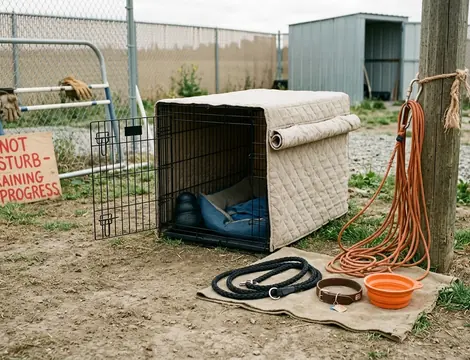
Here's where owners need a clear line. Most dogs value certain items more than others, and a brief reluctance to give up a prized chew is well within normal range. That is high-value attachment, and it resolves the moment the perceived threat passes.
Clinical resource guarding looks different. The anxiety response lingers. We often diagnose it when the dog's distress persists for more than something like 10 to 15 minutes after the threat has already left the area — a body still flooded with stress hormones long after the trigger is gone. That sustained physiological state, not the growl itself, is the clinical signal.
Identifying Triggers and Early Warning Signs
Most bites attributed to "no warning" had plenty of warning. Owners simply weren't reading the early chapters of the story. Guarding escalates through a predictable sequence, and the loudest signals come last.
Before any growl, watch for the subtle tells: whale eye, where the whites show as the dog tracks you sideways; a sudden stillness in the jaw; a body that goes rigid; a quick lip lick. These are not random. They are negotiation.
The freeze is the most important cue to learn. A pre-bite freeze typically lasts 1 to 4 seconds, give or take — a narrow window where the dog has decided the threat is real and is loading the next response. Read the freeze, and you can stop the entire sequence before it reaches a snap.
Mapping the Trigger Categories
Trainers categorize triggers by mapping the dog's spatial awareness, finding the exact radius where relaxed eating tips into defensive posture. Common categories include:
- Food bowls — the classic, though far from the most dangerous.
- High-value chews, bully sticks, marrow bones, long-lasting items.
- Stolen items, often the highest-intensity guarding, because the dog knows it shouldn't have it.
- Spatial guarding, beds, couches, doorways. These triggers often activate when a person or animal crosses into a 4- to 6-foot radius, more or less, of the resting spot.
Context shapes intensity more than the item does. A dog may happily relinquish a tennis ball at the dog park but aggressively guard a stolen tissue in the confined space of a living room. The resource isn't the point. The dog's sense of escape and threat is.
Never Punish the Growl
Punishing a dog for growling over a bone suppresses the warning signal, leading to a dog that bites without any audible or visual precursor.
This is the single most consequential mistake an owner can make. The growl is information. It is the dog telling you, clearly and non-violently, that it feels cornered. Correct the growl and you don't fix the fear — you just delete the warning system that sat between fear and teeth. The fear remains. The communication does not.
Scope and Limitations of At-Home Behavioral Modification
I'm an advocate for owner-led training. I'm also realistic about where it ends. Some presentations belong in professional hands from the first session, and recognizing that threshold is itself a skill.
Bite history is the clearest dividing line. When punctures go deeper than the length of the dog's canine teeth — a Level 4 on the Dunbar bite scale, at-home work is no longer appropriate. That severity calls for immediate veterinary behaviorist intervention, often alongside medication.
Risk Factor: Owner-led modification is strictly contraindicated for dogs guarding invisible or phantom resources — guarding empty space, an unseen spot on the floor, nothing the owner can identify. This pattern typically requires pharmacological support and professional oversight, because the trigger cannot be managed if it cannot be located.
Management Comes Before Training
Active training never starts on day one. Safety protocols dictate establishing a baseline of environmental management first, so the dog has zero opportunities to rehearse the guarding behavior while you assess it. Every practiced repetition makes the pattern stronger. Prevention buys you a stable starting point.
Practical management means feeding behind closed doors, removing high-value items from circulation, and using opaque visual barriers. Those barriers should stand a minimum of 36 to 40 inches high in most home setups to genuinely block line-of-sight triggers — a low pet gate the dog can see over accomplishes nothing.
For a deeper clinical overview, the veterinary behavior research on resource guarding from the University of Illinois is a sound reference point.
Step-by-Step Desensitization and Counterconditioning
The goal of counterconditioning is deceptively simple: change how the dog feels when a human approaches its resource. We're not teaching the dog to tolerate the approach. We're teaching it to welcome it, because good things reliably follow.
Older protocols tried the opposite of this and paid for it. The "empty bowl" method had owners physically lift the bowl to add food, which sounds generous but inadvertently taught the dog that human hands take things away. It reinforced the exact fear of loss it meant to cure. The approach was retired once the mechanism became clear, and the field moved toward distance-based, additive methods.
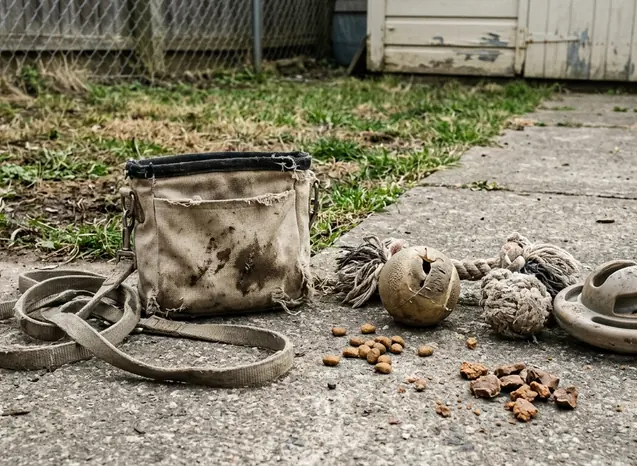
"Drop It" and "Trade Up" build the core skill. The principle is that you never take — you exchange, and the exchange always favors the dog. Approach with something better than what it holds, offer the trade, and let the dog choose to release.
Cut trade items into roughly 1/4-inch cubes so the dog can swallow them fast. A large treat the dog has to settle down and chew can become a new resource to guard, which defeats the purpose. Quick consumption keeps the emotional momentum moving.
The Phased Walk-Past
For food-bowl guarding, distance is the dial you control. Begin where the dog stays relaxed — initial counterconditioning often starts at 8 to 12 feet, adjusted to the individual animal's threshold.
- Walk past at your starting distance and toss a high-value treat near the bowl. Keep moving. Don't stop, don't reach.
- Repeat across many sessions until the dog looks up at your approach with happy anticipation rather than tension.
- Only then reduce the distance by a small margin, and rebuild the positive association at the new range.
- If the dog stiffens or freezes at any point, you've moved too fast. Step back to the last comfortable distance.
Key point: Progress in this work is measured by the dog's relaxation, not by how close you can get. A relaxed dog at six feet is a better outcome than a tense dog at two.
Practical Applications in Multi-Pet Households
Multi-dog homes add a variable you can't reason with: a second dog, also running its own retention programming. Guarding over scattered toys or shared feeding stations is among the most common conflicts I see, and competition is the engine driving it.
When structuring these environments, behaviorists prioritize visual isolation over simple physical separation. Line-of-sight alone can trigger anticipatory guarding — a dog that can see another dog eating may guard its own bowl before any actual approach occurs. Solid barriers, not just distance, do the heavy lifting.
Structured Feeding Removes Competition
The reliable setup combines solid visual barriers between feeding stations with strict timing. Bowls come up after a short meal window, usually 10 to 15 minutes after the meal begins, eliminating the lingering tension that builds when food sits out and dogs circle it. Structure replaces vigilance.
- Feed each dog in a visually separate space, ideally behind a solid barrier.
- Pick up all bowls on schedule, whether or not every dog has finished.
- Keep high-value chews to crated or separated sessions — never scattered communally.
Reintroducing Shared Spaces
Patience defines this final phase. Reintroducing shared spaces requires 6 to 8 weeks of incident-free individual feeding in the training plan before you even consider it. The thresholds of each dog must improve in isolation before they're tested together.
When you do reintroduce, do it the way you did the walk-past: gradually, watching for the early body-language cues, and ready to increase separation at the first freeze. One incident during reintroduction can undo weeks of progress, because it teaches both dogs that the shared space is, in fact, dangerous.
Guarding is treatable, and the prognosis for fear-based cases caught early tends to be encouraging. The framework here reflects current behavioral consensus, but every dog scales these protocols at its own pace — and a dog with any bite history deserves a hands-on assessment before any home plan begins.