Reliable obedience is not a manners project. It is a safety system built one clean repetition at a time.
When I teach foundational commands, I do not start with what looks impressive in a living room. I start with the behaviors that change risk: stopping forward motion, interrupting a bad choice, lowering arousal, and giving the handler a repeatable way to communicate under pressure.
What's Inside
- Establishing a Behavioral Foundation
- Criteria for Selection: Why These Five?
- 1. The Emergency Recall: “Come”
- 2. The Default Position: “Sit”
- 3. Impulse Control: “Stay”
- 4. The De-escalation Posture: “Down”
- 5. Hazard Avoidance: “Leave It”
- Scope and Limitations of Basic Obedience
Establishing a Behavioral Foundation
Unpredictable environments expose weak training fast. A dog who responds in the kitchen may ignore the same cue near a squirrel, a loose dog, a dropped chicken bone, or a guest stepping through the front door.
That is why basic obedience belongs in the safety category, not the party-trick category. The point is not to produce a polished performance. The point is to establish a shared language that lowers canine anxiety and reduces handler frustration.
Based on participant logs, initial behavioral foundations typically need 10 to 14 days of consistent 5-minute daily sessions before the communication loop becomes reliable. Longer sessions are not automatically better. Canine cognitive fatigue often appears after 8 to 12 minutes of continuous new skill acquisition, especially in puppies or adolescent dogs.
Critical Insight: If a dog looks scattered after several correct repetitions, the next step is usually a break, not a louder cue.
Socialization also matters because obedience does not happen in a vacuum. Dogs need calm exposure to people, surfaces, sounds, and movement patterns; the American Veterinary Medical Association guidelines on canine socialization give useful context for that early exposure window.
Criteria for Selection: Why These Five?
The five commands below were selected through a practical filter: emergency utility and impulse control. I excluded behaviors that look tidy but do little to prevent hazards.
For emergency utility, the question is blunt: can this cue stop or redirect a dog at a distance of up to somewhere around 30 feet? For mechanical foundation, the question changes: can this behavior transition into at least three advanced behaviors later in training?
What made the cut
- Come stops distance from becoming danger.
- Sit creates a default pause before jumping, rushing, or crowding.
- Stay teaches duration and delayed access.
- Down lowers physical intensity and supports settling.
- Leave It interrupts contact with unsafe items.
This is also a public-safety list. A dog who can pause at a doorway, ignore a dropped object, or return before crossing a street is easier to manage around neighbors, children, delivery workers, and unfamiliar dogs.
Recommendation: Teach these commands as small motor patterns first. Add real-world distractions only after the dog understands the movement and the reward pattern.
1. The Emergency Recall: “Come”
Recall is the single most critical command for preventing accidents. It is the cue I protect most carefully because it must stay emotionally clean.
A common mistake is calling the dog for something unpleasant: nail trims, the end of play, scolding, or confinement. The dog learns the cue predicts loss. Then the handler needs the word during an emergency and discovers the dog has been rehearsing avoidance.
Build the cue before you test it
Start indoors at a 6-foot distance. Say the cue once, move backward to invite pursuit, and reward when the dog reaches your immediate physical space. Reinforcement delivery needs to happen within something like 2 seconds of the dog returning, or the lesson becomes muddy.
Outdoor work should move to a 15-foot to 20-foot long line in an enclosed space. This is where reinforcement quality matters. Initially, standard dry kibble may work indoors, but it often loses to grass, odor trails, and moving wildlife outside. For outdoor recall proofing, high-value, moisture-rich rewards usually compete better.
High-value treats required for outdoor recall proofing may cause digestive upset if used for the high-repetition indoor shaping of stationary commands like sit or down. Use them strategically, not by the handful during every drill.
- Practice at 6 feet indoors with no visible distractions.
- Add mild movement, such as a family member walking across the room.
- Move to an enclosed outdoor area with a long line.
- Reward close body position, not just movement in your direction.
- End before the dog slows down or starts scanning away from you.
Risk Factor: Repeating “come” while the dog ignores you teaches the dog that the first cue is optional. Reduce distance or distraction instead.
2. The Default Position: “Sit”
Sit is a pause button.
That sounds simple, but simple is useful. A dog cannot jump on a guest and hold a sit at the same time. A puppy cannot launch at a food bowl and keep hindquarters on the floor. The command gives the dog an alternate behavior that is easy to pay for and easy for humans to recognize.
Use the lure; skip the push
Mark the choice, not the retreat
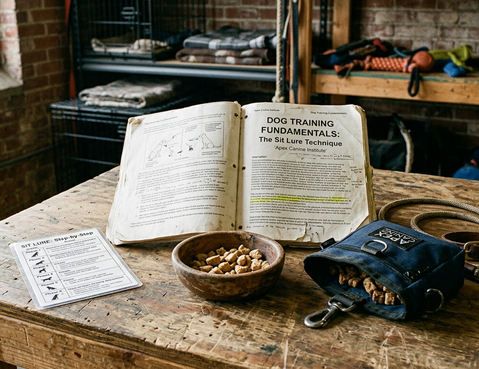
The cleanest sit usually comes from luring, not physical manipulation. Hold the reinforcement exactly 1 to 2 inches above the dog’s nose and move it slowly backward toward the ears. As the head follows the food, the hindquarters naturally fold.
Mark and reward the millisecond the dog’s hindquarters touch the floor. That timing tells the dog which part of the movement earned reinforcement.
Pushing a dog’s hindquarters down to force a sit often triggers an opposition reflex, causing the dog to push back and stand firmer rather than yielding to the posture. It can also make handling feel confrontational, especially for sensitive puppies and newly adopted dogs.
- Use a soft treat small enough for quick delivery.
- Keep the lure close to the nose so the dog does not jump for it.
- Mark the floor contact, then feed in position.
- Release before the dog pops up on their own.
Once sit becomes fluent, use it at predictable transition points: leash clipping, door opening, greeting visitors, and meal placement. Those repetitions turn obedience into household rhythm.
3. Impulse Control: “Stay”
Stay teaches the dog that holding position has value. It is less about stillness and more about emotional regulation.
The handler has three variables to manage: Duration, Distance, and Distraction. I teach them separately because combining them too early creates guessing. A dog who breaks position may not be disobedient; the criteria may simply be too stacked.
Start with duration
Initial duration targets should sit between 3 and 5 seconds before the handler adds even a single step of distance. That short window gives the dog a clear win. The release word comes immediately after the duration target is met, so the dog understands when the expectation ends.
- Cue sit or down.
- Say “stay” once.
- Count 3 seconds silently.
- Mark calm position.
- Use a release word before movement begins.
Door-dashing is where stay becomes more than obedience homework. The dog learns that an opening door is not permission to bolt. Feeding routines benefit too; the bowl arrives only after the dog can hold position briefly and wait for release.
Recommendation: If the dog breaks stay twice in a row, cut only one variable. Shorten duration, reduce distance, or remove distraction. Do not correct all three at once.
4. The De-escalation Posture: “Down”
Down changes the dog’s body, and the body often changes the emotional state. A standing dog can spring forward. A dog lying on the floor has fewer explosive options.
This is not magic relaxation. It is a mechanical posture that supports lower arousal and longer settling, especially in public spaces such as cafes, training classes, patios, or veterinary waiting rooms.
The L-lure
The L-lure is efficient because it guides the dog without pressure. Start with the dog sitting or standing. Move the treat straight down to the floor between the front paws, then pull it outward 4 to 6 inches along the floor away from the front feet. That outward motion encourages the elbows to drop.
Mark when the elbows meet the floor. Feed low so the dog does not immediately bounce up.
Dogs holding a down position for 3 to 4 minutes, more or less, commonly show visible signs of lowered respiration rates and decreased physical arousal. Watch the whole dog: softer eyes, slower breathing, less paw movement, and reduced scanning.
- Reward between the paws to keep the head low.
- Build duration before asking for cafe-level calm.
- Practice on non-slippery surfaces first.
- Release clearly so the dog does not self-release.
Critical Insight: Down is most useful when it predicts safety, space, and reinforcement. If it becomes a punishment posture, many dogs resist it.
5. Hazard Avoidance: “Leave It”
Leave It prevents contact. That is the core job.
The command matters when a dog notices medication on the floor, spoiled food near a trash can, a sharp object, wildlife waste, or another dog’s toy. It teaches that disengaging from a low-value environmental item can produce a better outcome from the handler.
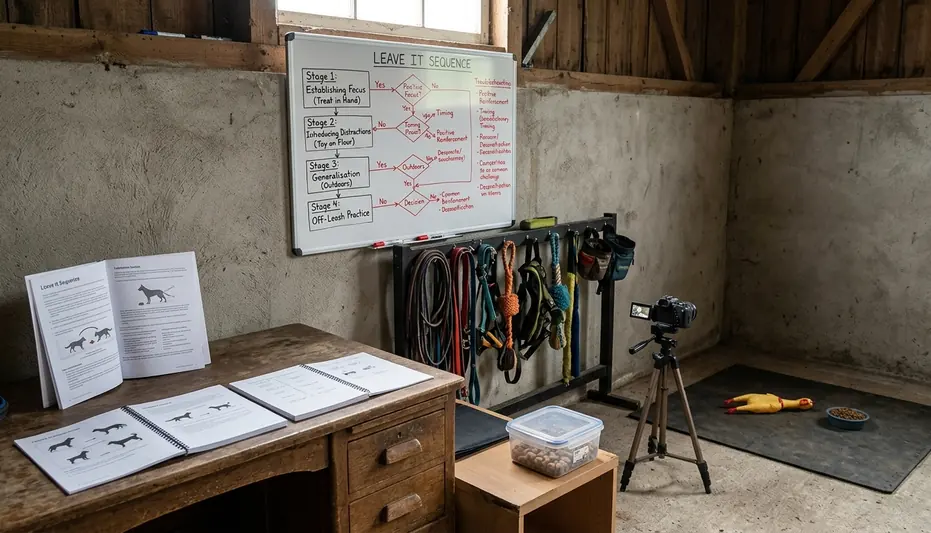
Begin with low-value bait, such as a piece of dry cereal, placed 3 to 4 feet away from the dog. The handler controls access. The dog looks at the item, then eventually shifts gaze away from it. That gaze shift is the behavior to mark.
The reward marker must arrive within about a second of the dog shifting gaze away from the restricted item. Waiting until the dog walks back can accidentally reward movement rather than disengagement.
- Place low-value bait where the dog can see it but not grab it.
- Say “leave it” once.
- Wait for the dog to break eye contact with the bait.
- Mark immediately.
- Reward from your hand, not from the restricted item.
Boundary setting has to stay consistent. If the dog sometimes earns the forbidden item after leaving it, the cue becomes a negotiation. For safety work, that ambiguity is too expensive.
Risk Factor: Do not practice Leave It with medication, cooked bones, toxic plants, or unsafe objects. Use controlled training bait and prevent rehearsal with real hazards.
Scope and Limitations of Basic Obedience
Foundational commands are powerful, but they are not a complete behavior-modification plan.
A dog with severe reactivity, separation distress, thunderstorm panic, or aggression may know sit, stay, and down perfectly in quiet conditions and still lose access to those behaviors during high arousal. Foundational obedience commands cannot override a dog’s autonomic panic response during a severe phobic episode, such as thunderstorm anxiety or extreme separation distress.
Professional intervention is typically recommended when a dog’s recovery time after a trigger exceeds 15 to 20 minutes, give or take. Reactions that occur at distances greater than 50 feet from a trigger often require specialized desensitization beyond basic obedience. This threshold is a triage marker for training decisions, not a diagnosis of the dog’s temperament.
What obedience can and cannot do
- Can do: create predictable communication during daily routines.
- Can do: reduce preventable hazards such as door-dashing, jumping, and object grabbing.
- Can do: support confidence when paired with exercise and enrichment.
- Cannot do: erase fear learning by repetition alone.
- Cannot do: replace a structured plan for aggression or panic.
Pair these five commands with adequate physical exercise, food-based enrichment, rest, and realistic expectations. A tired, mentally satisfied dog learns faster than a dog who has spent the day under-stimulated and then gets asked to self-regulate at the hardest moment.
The goal is not robotic obedience. The goal is a dog who understands what to do next, and a handler who can ask clearly before the environment makes the choice for both of them.