Crate training works best when it looks boring from the outside: puppy walks in, finds something predictable, settles, and comes back out before panic or frustration takes over. That quiet sequence is not luck. It is a training plan.
I treat the crate as a measurable puppy foundation skill, the same way I treat recall or leash manners. Duration, vocalization, body posture, elimination timing, and recovery after release all matter. If those markers move in the wrong direction, the protocol needs adjustment.
What's Inside
- The Psychology Behind Crate Training
- Analyzing Common Crate Training Failures
- Selecting and Preparing the Right Crate
- Step-by-Step Crate Introduction Protocol
- Managing Nighttime and Extended Absences
- Scope and Limitations of Crate Usage
The Psychology Behind Crate Training
Denning instinct, translated carefully
Canine denning instincts peak during the critical socialization period between about 3 and 14 weeks of age. That window does not mean every puppy automatically loves confinement. It means many puppies are developmentally ready to learn that a small, predictable resting place can be safe.
The mistake is treating instinct like a switch. A crate is not a natural den just because it has four sides and a door. It becomes den-like when the puppy can enter voluntarily, rest without interruption, and predict that confinement ends before distress builds.
Stress reduction through visual control
Some trainers frame crates as maternal den analogs after noting that puppies often show fewer stress signals, such as pacing and excessive panting, when the crate restricts visual stimulation. Puppies introduced to a visually restricted crate environment typically exhibit settling behaviors within roughly 12 to 18 minutes.
That timing band is useful, but it is not a stopwatch command. These settling ranges describe ordinary training responses in puppies without severe confinement distress; they should not be used to override escalating panic, self-injury, or repeated elimination.
For a puppy in a busy home, the crate can reduce decision load. No toddler reaching over the dog bed. The older dog is not stealing the chew. No constant hallway motion triggering watchfulness.
Critical Insight: The crate must predict safety, not social removal. If the puppy experiences it as isolation, the equipment is doing the opposite of the training goal.
That distinction matters most during the first week. A puppy who settles in the crate learns to downshift. A puppy who panics in the crate learns that barriers are dangerous.
Analyzing Common Crate Training Failures
The punishment problem
The fastest way to damage crate training is to send the puppy there immediately after a house-soiling accident or biting episode. Using the crate as a punishment zone creates a negative association and can trigger barrier frustration.
Trainers once used crate time-outs during puppy biting phases more casually. That approach got dropped in serious foundation work after puppies began avoiding the crate even during neutral moments. The fallout was not subtle: bracing at the door, refusing food inside, and vocalizing before the latch even moved.
Risk Factor: If the puppy only enters the crate after human frustration rises, the crate becomes a predictor of conflict.
A better interruption is brief management without poisoning the crate: step over a gate, redirect to a chew, or pause play. Then return to crate practice later, when the puppy is calm enough to learn.
Rushing desensitization
Forcing a puppy into a crate before desensitization can trigger barrier frustration within something like the first 48 hours of training. That early reaction often looks like scratching, spinning, barking in rapid bursts, or biting the bars.
Once that pattern starts, owners tend to get stuck in a noisy loop: let the puppy out and risk reinforcing vocalizing, or leave the puppy in and deepen the distress. The cleaner plan is to avoid creating the loop.
When the crate is too large
Housebreaking fails when the crate functions like a bedroom with a bathroom attached. Puppies provided with crates exceeding their body length by somewhere around 6 inches or more frequently eliminate in the far corner, then sleep away from the mess.
That is not spite. It is spatial logic.
The crate should fit the puppy’s current body, not the adult size you expect later. A divider panel solves this, as long as you adjust it before the puppy becomes cramped.
Selecting and Preparing the Right Crate
Wire, plastic, and soft-sided crates
Close the door in measurable increments
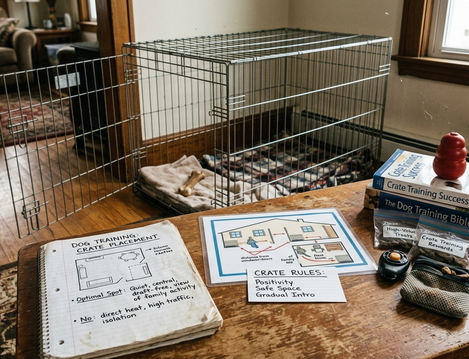
Crate choice should follow the puppy in front of you. Wire crates offer more airflow for double-coated breeds in warmer climates, whereas plastic airline-style crates provide better visual restriction for easily overstimulated herding breeds.
Soft-sided crates have a narrower use case. I reserve them for puppies who already have calm confinement skills, because fabric walls do not hold up well against chewing, pawing, or panic-driven escape attempts.
- Wire crates: best airflow, easiest divider use, more visual exposure unless covered.
- Plastic crates: stronger visual boundary, travel-friendly shape, less airflow than wire.
- Soft-sided crates: lightweight and portable, but unsuitable for active chewers or untrained puppies.
For heavy chewers, wire crates constructed from 9-to-11 gauge steel are required to prevent bending. That specification matters more than brand language.
Fit and growth adjustment
The correct crate allows the puppy to stand, turn around, and lie down comfortably. Not pace. Not play fetch with a stuffed toy. Just rest in several natural positions.
Divider panels should be moved back 2 to 3 inches, more or less, every 10 to 14 days to accommodate growth. Put that reminder on the calendar. Puppies can outgrow a setup before the family notices, and discomfort can masquerade as training resistance.
Placement inside the home
The best location is usually a peripheral corner of a main living space. This balances ambient family noise with enough quiet for sleep.
A laundry room may seem practical, but isolation can intensify protest in young puppies. The center of the living room has the opposite problem: too much visual traffic, too many invitations to stay alert.
Recommendation: Set the crate where the puppy can hear normal life without being stationed in the middle of it.
Crate Setup and Placement Criteria
- Divider panel installed to restrict length to the puppy’s current size.
- Plush bedding removed and replaced with a durable mat if the puppy is an active chewer.
- Breathable crate cover applied to the top and two sides.
- Door checked for smooth closure before every early training session.
- Water plan matched to age, weather, and veterinary guidance.
Step-by-Step Crate Introduction Protocol
Start with open-door exploration
The first goal is not confinement. The first goal is approach behavior.
Scatter high-value treats just inside the threshold and let the puppy choose the entry depth. Keep the door open. Avoid hovering over the crate entrance, because body pressure from a person can make the opening feel like a trap.
If the puppy steps in and steps out, count that as useful information. The puppy is sampling the space.
Use meals for classical conditioning
Feeding inside the crate builds a clean association: crate predicts food, food predicts comfort, comfort predicts rest. In practice, the bowl often needs to start at the threshold rather than at the back wall.
Move the food bowl inward by 4 inches per meal, give or take, during the initial classical conditioning phase. That small shift prevents the common hesitation that appears when the bowl jumps too far too fast.
Once the puppy eats comfortably with all four paws inside, begin door movement without latching. Touch the door. Swing it one inch. Open it again. Pay the puppy.
Based on participant logs, duration increments should start with 3 to 5 second door closures, progressing to 45 seconds, and then 3 minutes over a 48-hour period.
- Open-door treat scatter until the puppy enters without hesitation.
- Threshold feeding, then bowl movement inward by 4 inches per meal.
- Door movement without latch while the puppy remains engaged with food.
- Latched closure for 3 to 5 seconds.
- Quiet release before whining or pawing begins.
- Progress to 45 seconds, then 3 minutes, while tracking body posture.
Do not stretch the duration just because the previous repetition looked good. Puppies are not linear machines. A short, successful repetition protects tomorrow’s session.
Critical Insight: Release timing teaches the puppy what calm confinement feels like. Ending before distress is not spoiling; it is skill construction.
Managing Nighttime and Extended Absences
The pre-crate routine
Night success starts before the puppy enters the crate. Pre-crate physical exercise should conclude around 20 to 30 minutes before confinement to allow the puppy’s heart rate to return to baseline.
That gap matters. A puppy who races straight from tug into the crate may be physically tired but still neurologically activated.
- Offer an elimination trip.
- Use calm sniffing or a low-arousal food puzzle.
- Dim the room and reduce household movement.
- Guide the puppy to the crate with food, not pushing hands.
Night vocalization: distress or strategy?
A 10-week-old puppy can typically hold its bladder for roughly 3.5 to 4.5 hours overnight due to metabolic slowing. That range gives owners a planning tool, not permission to ignore a puppy who sounds distressed.
Preemptive alarms help. Wake the puppy for elimination before crying begins, carry or calmly lead the puppy outside, keep the trip dull, then return to the crate. This prevents the puppy from learning that barking is the reliable way to open the door for bathroom access.
Distress vocalization tends to escalate, pair with frantic movement, or continue after a quiet bathroom trip. Attention-seeking vocalization is often more intermittent and may pause when the room becomes boring. Watch the whole puppy, not just the sound.
Working-owner scheduling
Extended absences require math and humility. Young puppies cannot be crated through a standard workday and still receive fair housebreaking instruction.
For owners with fixed schedules, the realistic framework is a midday break from a trusted person, a safe puppy pen attached to an elimination area, or adjusted work blocks during the early months. Veterinary behavioral guidelines on crate training also emphasize that crate use should support welfare rather than replace supervision.
Recommendation: Build the schedule around the puppy’s elimination capacity first, then layer crate duration on top of that capacity.
Scope and Limitations of Crate Usage
Ethical duration limits
Crates are management tools. They protect puppies from electrical cords, unsafe chewing, conflict with other pets, and unsupervised house-soiling. They do not teach everything a puppy needs to know.
Maximum continuous daytime confinement for puppies under 14 weeks is usually capped at 2.5 to 3 hours. Puppies require about 45 to 60 minutes of unconfined, interactive floor time between crating sessions.
That floor time should include more than wandering loose while humans answer email. It should include elimination, movement, handling practice, chewing outlets, brief training, and social contact.
When traditional crating is contraindicated
Some puppies do not need a tougher crate plan. They need a different professional pathway.
Traditional crate training protocols are contraindicated for puppies exhibiting clinical separation anxiety, characterized by self-injurious escape attempts or hypersalivation. Those cases require veterinary behaviorist intervention rather than standard desensitization.
Risk Factor: Repeated escape attempts, blood on the crate, soaked bedding from drool, or panic that persists after elimination needs professional assessment.
The crate cannot replace training
A crate can prevent rehearsal of unwanted behavior, but it cannot socialize a puppy to visitors, teach recall, install leash manners, or build comfort with handling. Active training still carries that load.
The strongest crate plans are almost invisible in adult life. The dog can rest behind a barrier when needed, travel safely, recover after surgery, or relax during household disruption. But the crate is no longer the center of the behavior plan.
That is the real success marker: not a puppy who spends more time confined, but a puppy who learns to settle, trust the routine, and rejoin the household ready to practice the next skill.