What's Inside
- Why the Chime Sends a Dog Skidding Toward the Door
- Feelings Before Sits: Rewiring What the Chime Means
- Setting Up the Foyer Before the First Drill
- Five Milestones From Mat to Open Door
- Surprise Packages, Second Dogs, and the Driveway Signal
Why the Chime Sends a Dog Skidding Toward the Door
Most standard mechanical and wireless doorbells chime at somewhere between 75 and 85 decibels. Before that note has finished fading, nails are scrabbling for traction on the hardwood, a body hits the front door, and barking echoes up the hallway. In many Memphis homes this is the most predictable minute of the day. It is also the most chaotic.
The frenzy looks spontaneous. It runs on a very tidy piece of learning.
A Sound That Predicts Something Big
A doorbell carries no built-in meaning for a dog. Through repetition it becomes a conditioned stimulus, a sound that reliably predicts either an exciting social arrival or a stranger stepping onto the property. The sharp acoustic spike triggers an immediate sympathetic nervous system surge, so the dog is already in motion before any learned cue has a chance to register.
Behavior consultants separate two quite different motivations at the threshold. They watch tail carriage, look for ear pinning, and time how long the dog takes to settle after the guest is inside. A hyper-social greeter tends to carry a loose, wagging tail and decompresses fairly quickly. A dog guarding territory is more likely to pin its ears or stiffen, and it stays keyed up long after the door shuts. That post-arrival decompression latency is one of the most useful clues when choosing between a social-greeting plan and a territorial behavior modification plan.
How the Household Pays for the Frenzy
The loop sustains itself. A guest walks in, the dog jumps, and the guest looks down, laughs, pushes the paws away, or says the dog's name. Eye contact, touch, and voice all count as attention, and attention is exactly what a socially aroused dog wants.
Deliveries train the territorial side even more efficiently. A delivery driver typically spends 8 to 15 seconds on a residential porch. The dog explodes into barking, and within that short window the intruder retreats. From the dog's point of view, the barking worked, and it works on nearly every delivery.
Feelings Before Sits: Rewiring What the Chime Means
The usual response to door chaos is a string of obedience training cues: sit, quiet, leave it. Those are operant requests, asking the dog to perform a behavior in exchange for a consequence. The trouble at the door is emotional. The chime has come to mean alarm or overwhelming excitement, and a sit layered over that emotional state collapses the moment real arousal arrives.
Classical counter-conditioning works on the emotion itself. The chime is paired with food until the sound starts to predict something pleasant, and the dog's first reflex shifts from launching at the door to glancing at the handler. The classic conditioning and desensitization principles behind this approach depend heavily on order and timing. For the association to form, food delivery should begin within 0.5 to 1.5 seconds after the muted acoustic cue ends. If the treat arrives first, the dog learns to watch the treat pouch and the chime gains nothing.
Why Shouted Commands Go Nowhere
Once a dog breaches its cognitive reactivity threshold, learned cues stop landing reliably. Circulating cortisol and adrenaline then need 20 to 45 minutes of uninterrupted quiet to return to baseline. Each shouted "sit" adds noise to a nervous system that is already flooded, and the next ring of the bell finds the dog starting from a higher baseline.
That recovery window applies to a dog that has fully tipped over threshold, the one spinning and screaming at the glass. A dog that only lifts its head and offers a single bark is still within reach, and that dog can usually still take food, which is precisely the zone where training should happen.
Splitting the Arrival Into Micro-Triggers
To a dog, a visitor's arrival is a chain of separate cues, each one ramping arousal a little higher. The protocol in this guide breaks the human side of that chain into five isolated micro-triggers, practiced in order:
- Handler weight shift toward the foyer
- Deadbolt click
- Interior handle depression
- A 4-inch visual door crack
- Helper crossing the threshold
The doorbell runs as its own parallel track. The hierarchy starts with the handler's weight shift toward the hallway before any acoustic cue is introduced at all, because for many dogs the owner's movement is the earliest warning that someone is coming.
Setting Up the Foyer Before the First Drill
Equipment and placement decide whether the protocol succeeds or falls apart. Everything below goes in place before the first session.
The Boundary Target
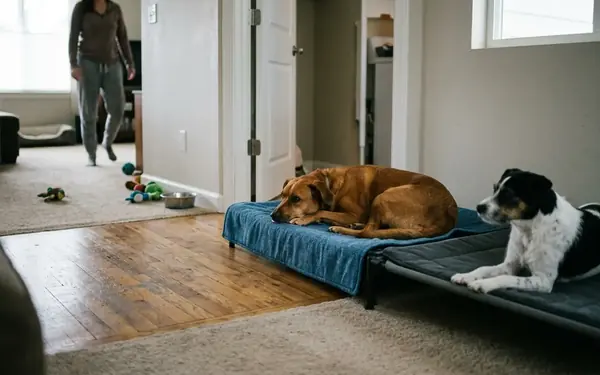
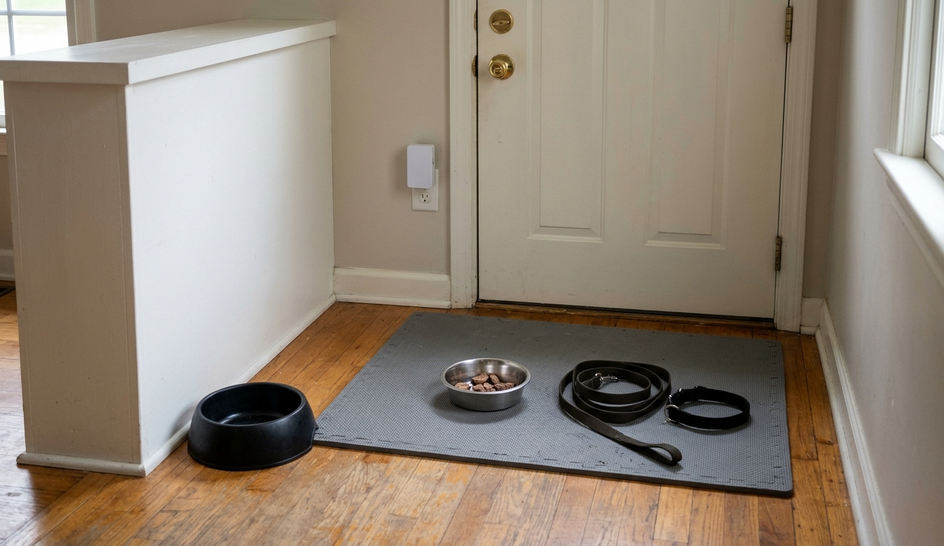
We started with plush, machine-washable bath mats as the boundary target, then retired them after high-arousal dogs hit the fabric at a run and skidded up to three feet across polished hardwood. A target that slides teaches nothing about stillness. Heavy-duty rubber-backed commercial mats or raised aluminum-frame cots hold their position, and on hardwood foyers the cot is usually the better choice.
Place the target 8 to 12 feet back from the inward door swing. That distance removes spatial crowding at the threshold and, ideally, blocks the dog's direct line of sight to the porch sidelights.
Barriers Between Sessions
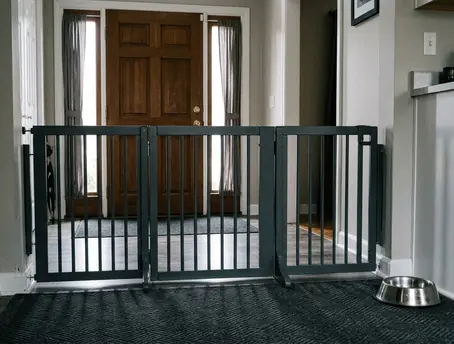
Every unmanaged rush to the door is a rehearsal of the old habit. A leash clipped to a tether point near the cot, a baby gate across the hallway, or simply a leash held by the handler keeps the dog from practicing the frenzy while new learning is fragile.
A Reward Hierarchy That Moves Fast
Door training calls for rewards the dog values highly and can swallow almost instantly. Pre-cut semi-moist options such as freeze-dried beef liver or boiled chicken breast into nearly 0.25-inch cubes. Store them in an airtight ceramic jar about 5 feet off the floor, close to the entryway but out of reach. At that size the handler can deliver 4 to 6 pieces in rapid succession without setting off prolonged chewing that stalls the session.
Know When the Foyer Is Off-Limits
Some dogs meet strangers with stiff-legged lunging, raised hackles, and deep-chested warning barks. That pattern points to severe territorial aggression, and those dogs need muzzle conditioning plus closed-door confinement in a separate room. An open-foyer mat protocol puts guests and the dog at risk.
Five Milestones From Mat to Open Door
Two rules govern the whole sequence. First, keep each desensitization drill to 3 to 5 minutes and cap the day at 8 to 12 doorbell repetitions, since more than that invites acoustic sensitization or plain fatigue. Second, advance only after the dog succeeds on four out of five attempts across three consecutive days, holding a relaxed posture throughout. A soft body and a dog that is still eating mark success. A rigid sit with a trembling jaw does not count.
Milestone 1: Targeting the Mat
With no door stimuli present, condition the dog to move to the cot or mat automatically and hold a stationary sit there. Feed generously on the target. Then add the first micro-trigger, a small weight shift by the handler toward the foyer, and feed the dog for staying put.
Milestone 2: Separating the Chime From the Alarm
Dampen the doorbell speaker with two layers of dense foam tape, or play a smartphone recording of the chime at approximately 20% volume. The moment the sound ends, deliver food on the mat within that 0.5 to 1.5 second window. Raise the volume in just about 15% increments across 9 to 14 days. The goal is a chime that makes the dog swivel toward the handler, expecting liver.
Milestone 3: Adding Handler Mechanics
Now the handler walks to the door while the dog stays anchored in a sit. Touch the deadbolt, pause there for 2 seconds, then return to the mat and feed the dog in place. Work through the deadbolt click and the handle depression, then begin cracking the door open, building to a 4-inch gap over 15 to 20 successful repetitions. Return to the dog often. Frequent reinforcement at the target holds the stay together.
Milestone 4: A Familiar Helper on the Porch
Recruit a calm friend the dog already knows. The helper rings the real bell while the handler runs the full sequence: chime, food, walk to the door, deadbolt, handle, 4-inch crack. The helper stays outside and ignores the dog. A drag leash on the floor gives the handler a quiet way to interrupt without grabbing at the dog's collar.
Milestone 5: Crossing the Threshold
Finally, the helper steps inside. The dog keeps its place on the cot while the guest enters, sets down a bag, and settles. Release the dog to greet only when it is still sitting relaxed, and ask the guest to offer attention only while all four paws stay on the floor. If the dog leaves the cot early, the guest steps back out and the repetition resets at the previous milestone.
Feed After the Sound
When progress stalls, check timing before anything else. Treats that appear before or during the chime teach the dog to watch the pouch, while treats delivered right after it change how the sound feels.
Surprise Packages, Second Dogs, and the Driveway Signal
Real life does not wait for Milestone 5. A courier will ring the bell during week one, and a second dog will bark along at the worst moment. Both need a plan.
Unscheduled Deliveries During Training
During the training phase, treat every unplanned ring as a management event. On days with expected deliveries, keep the dog behind a gate or in a back room with something to chew. Some households temporarily disconnect the bell or leave a note asking drivers to knock softly. If a surprise ring catches the dog in the foyer anyway, scatter a handful of treats on the mat, or lead the dog to another room, and accept the setback calmly. Ending one rehearsal of the frenzy early still protects the work already done.
When Barking Becomes Contagious
In multi-dog homes, social facilitation turns one alert bark into a chorus. Train each dog separately at first. One dog works on the hallway cot while the other waits behind a solid bedroom door with a stuffed marrow bone, and the dogs trade places. Keep that arrangement until each dog shows individual fluency.
When both dogs are ready to practice together, give each its own boundary cot in the same room, with at least 6 feet of lateral space between them. That buffer prevents body-blocking and competitive resource guarding over tossed treats, which can turn a calm greeting into a scuffle.
Calm Starts Before the Bell
Reward the dog for quiet attention at the first sign of alerting, such as a raised head or ears turning toward the street, before the bell rings.
That early alert has a physical explanation. Domestic dogs detect high-frequency sound up to 45,000 Hz, so the pneumatic hiss of a delivery van's brakes or the creak of a metal mailbox hinge can reach them 30 to 60 seconds before a person hears footsteps on the steps. The doorbell arrives near the end of a long chain of cues, and a calm greeting starts at the first ear twitch toward the driveway.