When Every Extra Step Teaches Your Dog to Pull
A walk can leave an owner managing persistent shoulder pain, a dog lunging toward an intersection, or an injury that needs emergency veterinary care. Equipment and learned pulling can contribute to that chain of events. Loose-leash walking gives both ends of the leash something better: room to explore with a clear, responsive connection.
The mismatch often begins with good intentions. You extend a retractable leash so your dog can investigate a tree. Your dog presses forward, the reel releases more line, and access to the tree follows. From the dog's perspective, leaning into pressure worked.
The environment supplies the reward. Sniffing, approaching another dog, and reaching the next patch of grass can reinforce pulling even when you never offer food or praise for it.
I start with a practical question: what happens immediately after the leash becomes tight? If the dog keeps moving toward something desirable, the walking routine continues to reward tension.
On suburban sidewalks and busier urban routes, an equipment check helps separate that learned pattern from other contributors, including excitement, fear, or discomfort. Switching to a fixed lead in a quiet area can expose a habit of leaning forward even when no reel remains to extend. That observation helps shape the training plan; it does not establish the cause of every pulling episode.
Let Slack Unlock Sniffing
Choose an accessible sniffing spot. Approach while the leash hangs loose, pause safely when it straightens, and resume when your dog releases the tension. Access to the spot becomes part of obedience training.
The Retractable Spring Keeps Pressure in the Conversation
A retractable leash must retrieve its cord or tape. Its internal spring pulls backward while the dog supplies the forward force needed to extend the line. That mechanism creates a different tactile experience from a fixed leash hanging in a loose curve.
Consider the same tree. With a retractable reel, the dog leans forward, overcomes spring resistance, and gains distance. With a flat leash and a consistent loose-leash protocol, forward movement follows slack; sustained tension triggers a pause. These arrangements teach different relationships between pressure and access.

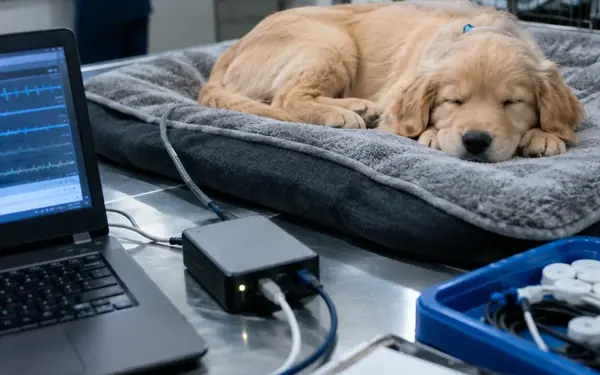
An inline luggage scale can make retrieval resistance visible: placed between the harness and retractable line, it can register tension while the dog stands still. The reading depends on the device and setup, so treat this as a demonstration of the mechanism rather than a universal force measurement.
The Thumb Brake Moves the Boundary
The brake introduces another learning problem. A handler may allow considerable distance along an empty path, then lock the reel close beside a driveway. The dog reaches the end at different distances without necessarily receiving an advance cue.
Dogs can learn contextual walking cues, but an inconsistently applied brake gives them little stable information about the available radius. Calling “easy” while continuing to release line also leaves competing consequences in place: the voice asks for restraint while movement still rewards forward pressure.
For puppy care, that distinction matters early. A predictable leash setup makes it easier to teach the desired walking pattern before pulling becomes a well-rehearsed route to exploration.
Run-Up Distance, Cord Wraps, and a Dropped Handle
Distance allows a dog to accelerate before reaching the leash endpoint. When a squirrel triggers a sprint, the eventual stop loads the equipment and the dog's attachment point abruptly. A collar concentrates that load around the neck; a harness changes where the force lands without eliminating the sudden stop.
Possible consequences include neck injury, handler imbalance, or equipment failure. An engaged plastic brake should never substitute for maintaining a manageable distance from traffic, animals, and pedestrians.
The housing also changes handling. A bulky grip can become difficult to retain during an unexpected lunge. If it drops, the casing may bounce and rattle behind the dog, adding a frightening noise that follows every attempt to escape.
Keep Limbs Clear
Never grab a moving retractable cord or let it wind around a leg. Thin line concentrates friction over a narrow contact area and can injure human skin or canine limbs. Stop movement and untangle only when the line is slack.
A flat leash still requires careful handling. Wrapping any line around fingers, allowing it to cross a walkway, or letting a dog build speed toward its endpoint creates avoidable risk.
Long lines have a separate job. A flat field line can support recall practice and decompression in suitable open space, with supervision and enough clearance to manage the trailing material. That use differs from extending a spring-loaded cord among pedestrians on a public sidewalk, where close positioning and direct feedback matter.
Include equipment checks in your dog's health & wellness routine. For broader walking precautions, review the preventive behavioral guidelines on safe walking equipment.
Build a Shared Walking Rhythm on a Six-Foot Flat Leash
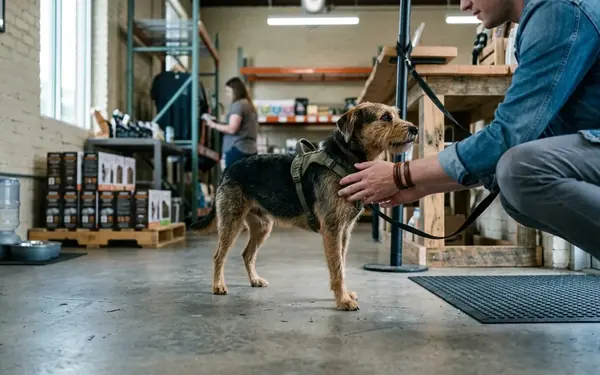
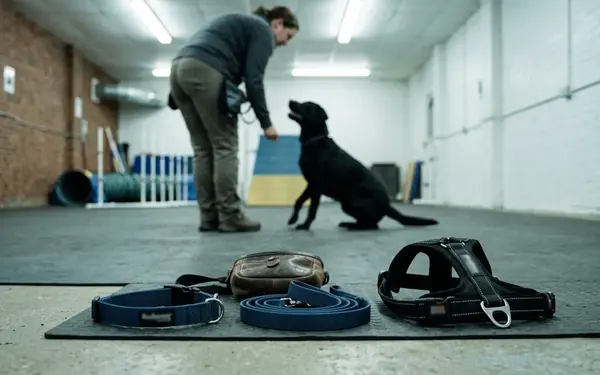
Choose a six-foot leather or Biothane flat leash with secure hardware. Pair it with a well-fitted Y-front harness that permits comfortable shoulder movement, or a flat collar when appropriate for the dog's health and handling needs. For a dog that lunges strongly, avoid rehearsing abrupt stops against the neck.
The fixed length provides a consistent maximum radius. Your hands manage the usable slack within it.
Teach the Release Before Adding Distractions
- Begin in a quiet hallway. Let your dog investigate the equipment, then reward standing near you with the leash loose.
- Introduce a gentle directional feel. Take up slack gradually without jerking or dragging. Mark and reward the smallest voluntary shift toward that feel, releasing pressure immediately. If your dog braces or appears worried, reset and use a food lure to clarify the movement.
- Reward the J-shaped curve. Take an easy step. Mark the moment the leash hangs loose, then deliver the reward near your walking position.
- Move onto the driveway. Keep the task familiar. When tension develops in a safe stopping place, pause; resume after your dog creates slack. Avoid turning the pause into a prolonged standoff.
- Record the actual task. Note where slack walking holds, what distraction precedes pulling, and whether recovery requires a food prompt. Compare similar routes before increasing difficulty.

Give Each Hand a Clear Job
In the anchor-and-guide position, secure the handle in the hand opposite the dog and keep that hand near your belt buckle. Use the nearer hand to feed or gather the strap smoothly. Avoid winding leash around fingers or locking a loop tightly around your wrist. Practice these movements while stationary before using them on a walk.
On Tuesday morning, Marcus and Barnaby approach the crosswalk. Marcus gathers a little leather before the curb, keeping the J-shaped curve visible. Barnaby glances up. Marcus marks the check-in, rewards beside his leg, and waits with him for the crossing signal.