Cortisol does not switch off when the front door closes. In dogs with genuine separation anxiety, that stress hormone can stay elevated for two to four hours, give or take, which means the owner who ducks out for a forty-minute errand often returns to a dog whose body has been in chemical alarm the entire time. The house was quiet. The dog was not.
What Four Hours of Elevated Cortisol Does to a Dog Home Alone
The first job in any behavior modification plan is telling two very different problems apart. A bored adolescent labrador with too much energy and too little to do will shred a sneaker, nap, shred a cushion, and nap again. The damage is scattered, the dog eats normally, and the chewing happens at random points across the day.
Clinical isolation distress looks nothing like that. The destruction clusters at exit points: door frames, window sills, the crate latch. Vocalization starts within minutes and rarely stops. Heart rate in these dogs frequently climbs past somewhere around 140 beats per minute inside the first ten to fifteen minutes alone, and the pacing that follows is frantic rather than restless.
That physiological difference matters because it determines whether training will work at all. Once the autonomic nervous system tips into fight-or-flight, the parts of the brain responsible for learning go quiet. A dog above their panic threshold is not absorbing a lesson about the door being harmless. They are surviving the next ninety minutes.
Threshold First, Training Second
Every protocol below depends on one rule: the dog must stay under threshold. Any session where the dog panics has taught them that panic was justified. Shorter and calmer always beats longer and braver.
How Keys, Shoes, and the Television Remote Turn Into Triggers
Dogs are exceptional pattern readers, and departures follow patterns. Classical conditioning does the rest. Neutral objects — keys on a hook, a coat over a chair, a particular pair of work shoes, acquire emotional weight simply because they reliably precede isolation.
The chain can run remarkably deep. Dogs can condition up to six sequential human actions into a single panic trigger, which is how a morning alarm ends up linked directly to the sound of the front door closing. By the time the owner reaches for their bag, the dog has already been escalating for a while. Pre-departure pacing and panting commonly begin twenty to thirty minutes before the actual exit, set off by something as small as the television clicking off.
Here is where comparison gets useful. Two dogs in the same household will not read the same cues with the same intensity. Genetic predisposition and rehoming history dictate a great deal: a protocol that stabilizes a well-socialized retriever within weeks may barely register for a rescue hound who has moved through multiple shelter transfers. The hound's learning history contains more evidence that people leave and do not come back.
Scramble the Sequence
Pick up the keys at 8pm while watching television. Put the work shoes on and cook dinner in them. Grab the coat, then sit down. Cues lose predictive power when they stop predicting anything.
Building Micro-Absences: The Door-Is-Boring Protocol
A common starting point is leaving the dog in a separate room with a high-value puzzle toy, on the theory that food will compete with the fear. Video monitoring frequently dismantles that theory. In one representative case the dog ignored the stuffed toy completely the moment the door clicked shut, then spent the next eleven minutes scratching the frame. The food had been irrelevant all along because the dog was already over threshold.
Shifting to micro-absences solved the problem the toy could not. The revised sequence began with the owner touching the doorknob without turning it, repeatedly, until the dog stopped lifting their head. Only then did the knob turn. Only then did the door open an inch.
Proper micro-absences are measured in one- to three-second intervals at the outset, timed so the owner returns before the nervous system reacts at all. A working session usually contains ten to fifteen false departures spread across a twenty-minute window, spaced out deliberately to prevent trigger stacking. Return, ignore the dog, sit down, repeat.
Sub-Threshold Departure Desensitization Checklist
- Identify every departure cue — keys, shoes, coat, bag, lights, television, and list them in the order they normally occur.
- Perform false departures by interacting with a single cue without leaving, repeating until the dog shows no orienting response.
- Combine two cues, then three, holding each combination until it produces boredom rather than alertness.
- Open the door without stepping through. Close it. Sit down.
- Step outside for one to three seconds and return before any vocalization, panting, or pacing begins.
- Build duration in small increments, varying the length so the dog cannot predict escalation.
- Record every session on video. Guesswork about what happens after the door closes is the single most common reason plans stall.
- When the dog crosses threshold, drop back to a duration they handled comfortably and rebuild from there.
Progress in this work is never a straight line. A dog managing fifteen minutes on Tuesday may fall apart at four minutes on Saturday because of a thunderstorm, a schedule change, or a bad night's sleep. Dropping back is part of the method, not a failure of it. The numbers cited here describe typical clinical patterns, and individual response curves vary enough that video review of the actual dog outranks any published timeline.
Crates, Red Flags, and the Four-to-Six-Week Medication Window
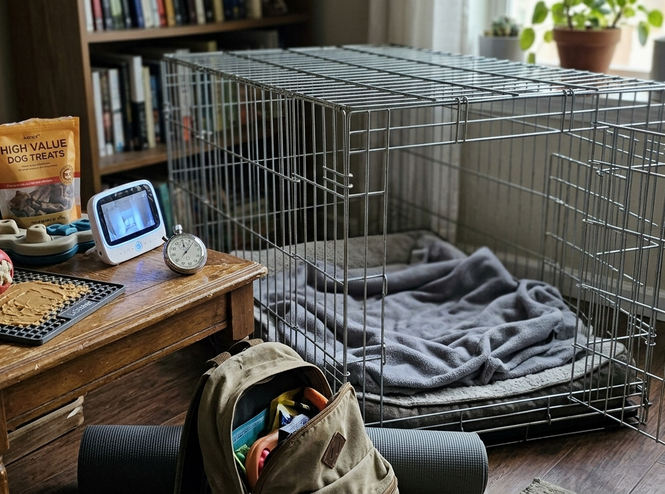
Confinement is worth examining as a trade-off rather than a rule. A free-roaming anxious dog has access to windows, doors, and furniture, which multiplies the opportunity for self-injury and expensive property destruction. A properly conditioned room with a baby gate keeps the dog contained without the sensation of being trapped. Heavy-duty crates sit at the far end of the spectrum, typically built from 18-gauge steel tubing with dual-latch systems specifically to prevent dental trauma and escape attempts.
The critical variable is conditioning. A crate the dog loves is a den. A crate the dog was shoved into on day one is a cage, and panic inside a cage produces broken teeth and torn nail beds.
Red Flags in the Crate
Bloodied paws, damaged teeth or gums, sustained refusal of food during absences, or destruction that risks injury all signal a case that has outgrown home management. These warrant clinical assessment rather than another week of duration building.
For severe cases, behavioral modification often needs pharmacological support. Medication is not a cure; it is a tool that lowers baseline arousal far enough that learning becomes physiologically possible. Veterinary-prescribed SSRIs generally require a four- to six-week loading period before that baseline shift shows up, which means desensitization work continues throughout the wait rather than pausing for it. These drugs must be prescribed and monitored by a licensed veterinarian, and complex aggression-adjacent or self-injurious presentations are best co-managed with certified applied animal behaviorists who can grade risk properly.
The Morning the Whining Stopped
Independence gets built the same way the panic did: through repetition, one association at a time. The transition from tolerating five-minute absences to resting calmly through ninety-minute absences typically takes three to five months of daily, sub-threshold practice. Alongside that, a densely packed frozen chew toy offers thirty-five to forty-five minutes of sustained licking, an action that self-soothes and lowers heart rate on its own.
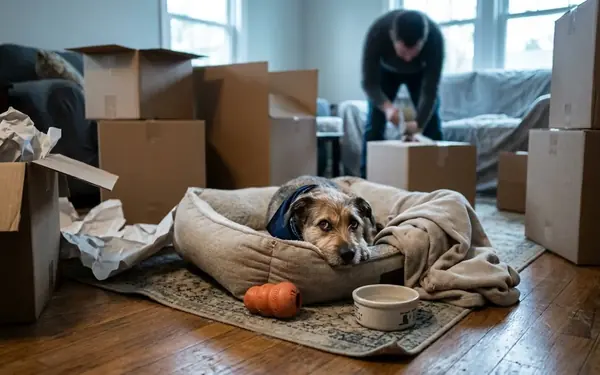
Picture a Tuesday in March. The hound, eighteen months out of her third shelter placement, is stretched on an orthopedic mat by the radiator, working a frozen chew with the steady rhythm of a dog who has somewhere to be and nothing to fear. Her owner lifts the keys off the hook. She glances up, then goes back to licking. Coat on. Bag over the shoulder. The door opens onto cold morning air, closes, and the hallway stays completely silent.