
A crisp Tuesday morning, not far from forty-five degrees, a quiet street with cars frosted over. The handler is just over three minutes into an easy walk, coffee in one hand, a six-foot biothane leash in the other. Then a skateboarder cracks around the corner, wheels grinding on concrete, and the dog goes vertical. Barking, lunging, leash snapped tight, handler spilling coffee and apologizing to no one.
That whole sequence takes under four seconds. And it is one of the most common presentations in companion dog behavior modification.
When the Skateboarder Rounds the Corner
Leash reactivity describes an outsized response to an environmental stimulus that occurs specifically while the dog is restrained. Barking, lunging, spinning, air-snapping, screaming. The behavior looks ferocious. The underlying state usually isn't.
When facing sudden environmental contrast, a dog's heart rate climbs within roughly one to two seconds of visual contact. The dog hasn't deliberated. The autonomic nervous system fired before anything resembling a decision could form, and the leash — which blocks the dog's two preferred options, approach or retreat, converts that arousal into an explosion.
When the foundational guidelines for this protocol were set, breed tendencies were deliberately left out of the frame. The baseline rests on autonomic responses instead, which keeps the same protocol applicable to a frustrated adolescent Labrador who desperately wants to greet, and to a fearful rescue terrier who desperately wants the skateboard to stop existing. Different motivations, identical physiology, same starting procedure.
Inherent aggression accounts for a small slice of these cases. Over-arousal, barrier frustration, and fear account for most of them.
Distance Is the Working Dose
A threshold is the distance or intensity at which a dog can perceive a trigger and still think. Inside it, the dog notices, processes, and chooses. Outside it, the dog reacts.
For fast-moving triggers like skateboards, cyclists, and scooters, workable threshold distances frequently begin somewhere between 40 and 60 feet. That number surprises handlers who have been practicing at fifteen feet with basic equipment and wondering why upward of six months of effort produced nothing. Fifteen feet was never training. It was rehearsal of the reaction.
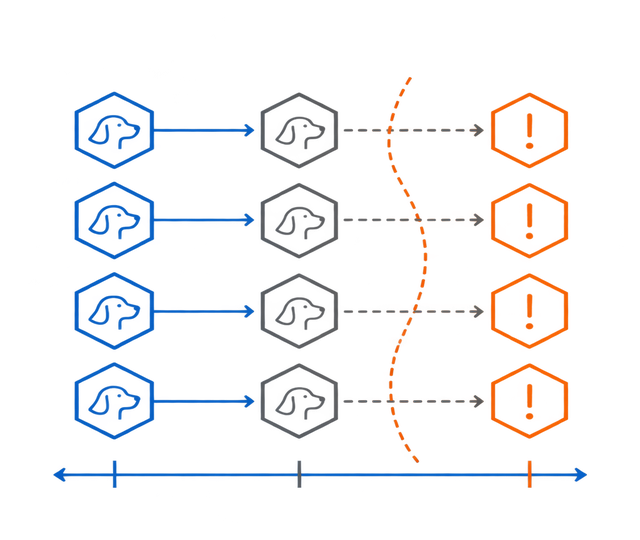
Past the threshold, the dog enters what handlers informally call the red zone. Food gets refused or taken and dropped. Known cues evaporate. The dog may not hear its own name. Learning in any meaningful sense has stopped, and every additional second of exposure is practice at panicking.
The cost of one red-zone episode isn't the four seconds of barking. It's the next two or three days.
That lingering cost has a name: trigger stacking. After a significant stacking event, cortisol clearance runs roughly 48 to 72 hours, and during that window the dog reacts faster, harder, and at distances that were comfortable the week before. A Saturday fireworks scare can wreck a Monday walk. Good protocols build recovery days in deliberately rather than treating every day as a training day.
Red Zone Red Flags
Distance management handles standard reactivity well. It is not the right first move for every dog. Severe panic responses — voiding bowels or bladder during an episode, for instance, or an established bite history warrant evaluation by a certified veterinary behaviorist before behavior modification begins, partly to rule out underlying medical anxiety or pain that no amount of counter-conditioning will resolve.
Trigger First, Then the Chicken
Counter-conditioning changes what the trigger means. Skateboard predicts roast chicken. Repeat enough times, far enough away, and the emotional response shifts from threat detection to anticipation.
Sequence is everything, and early versions of this protocol got it backwards. Handlers were coached to catch the dog's attention with food the instant they spotted a skateboard down the block, before the dog noticed. It failed in an instructive way: the treat started appearing a half-second before every scary thing, so the treat itself became the warning. Dogs began scanning anxiously at the sight of the food pouch. The sequence was rewritten to require the dog to perceive the trigger first, always.
- Set up beyond threshold. Pick a spot where the trigger is visible but boring. A parking lot edge, a park bench shy of forty feet off a bike path.
- Wait for the look. The dog's head turns, ears orient, eyes lock. That's the moment.
- Deliver inside the window. Food reaches the dog within a half to a full second of that visual lock. Later than that and the pairing weakens.
- Keep feeding while the trigger is visible. Stop the instant it leaves view. Trigger present, food flowing. Trigger gone, kitchen closed.
Pocket Mechanics
Use pea-sized, high-moisture treats a dog can swallow in under two seconds without chewing. Dry biscuits break the rhythm; crumbs on the sidewalk pull the dog's head down at exactly the wrong moment. Soft cheese, boiled chicken, hot dog coins.
Close distance only when the dog offers a relaxed look at the trigger followed by a voluntary check-in with the handler, consistently, across multiple sessions. Reduce the gap in small increments. If reactions reappear, the dog moved too close too fast, and backing up five feet is a correction to the plan rather than a setback.
Streets You Don't Control
Setups are clean. Neighborhoods are not. A delivery van parks, a gate opens, and suddenly a skateboarder is twelve feet away with nowhere to go.
The emergency U-turn covers most of it: a 180-degree pivot executed within about three seconds of spotting an unavoidable close-range trigger, cued cheerfully, rewarded on the move. Practice it on empty sidewalks until it's automatic, because a U-turn invented in the moment comes out as a panicked yank.
Environmental barriers do quiet work too. Step behind a parked car. Duck between hedges. Angle into a driveway. Visual interruption buys the few seconds a dog needs to drop back under threshold without any confrontation at all.
Cap active neighborhood sessions at 12 to 15 minutes. Cognitive fatigue hits handlers as fast as dogs, and tired handlers shorten the leash, hold their breath, and telegraph dread straight down the line. A loose leash and loose shoulders aren't decoration. They're data the dog is reading continuously.
Sniffing walks on a long line in an empty field, with zero training agenda, remain one of the more underrated tools in this work. Decompression and protocol progress tend to rise together.
Thirty Feet, Weeks Later
Same street. Same cold morning light. Same handler, same biothane leash, coffee in the car this time.
The skateboarder appears at the far end of the block, maybe thirty feet out. The dog sees him. Head up, ears forward, a half-step of stillness.
Then, inside two seconds, the dog turns back. Not because anyone asked. Because the skateboard means chicken now, and the chicken lives in the handler's left pocket. The leash stays in a soft J the whole time. The handler feeds, says something quiet, and they keep walking north while the wheels fade behind them.
Nobody on the street notices a thing. That's the point.