What's Inside
- Why one scare at nine weeks can outlast puppyhood
- How a quick startle differs from lasting fear
- When the socialization checklist pushes puppies into shutdown
- A distance-first exposure plan the puppy controls
- Keep strangers' hands off your ten-week-old puppy
Why One Scare at Nine Weeks Can Outlast Puppyhood
A five-week-old puppy hears a pan crash in the kitchen, scrambles back, and is sniffing the pan again within 15 to 30 seconds. Put the same pan and the same crash in front of a nine-week-old, and the noise can stay with that dog for years. Why does the brain change that much in a few weeks?
Timing explains most of it. Breeders usually release litters between Days 56 and 84 after whelping. That is the same stretch in which the puppy's fear circuitry comes online. Owners often say their puppy's temperament "changed overnight" after the move home. It did, and the move itself is only part of the reason.
Around week 8 or 9, myelination of the basolateral amygdala speeds up signaling in the region that tags events as dangerous. A sudden startle now triggers a norepinephrine spike, and that spike helps write the event into long-term memory. The sympathetic nervous system matures alongside it. Survival responses start to win out over the open curiosity of the earlier weeks.
The body keeps score too. A nine-week-old puppy's serum cortisol can stay high for 48 to 72 hours after one acute startle. A six-week-old still living with littermates usually clears it in under an hour. Your new puppy has also just lost that littermate buffer, and maternal antibodies are fading at the same point. Every scary event in this window costs more and takes longer to recover from.
How a Quick Startle Differs From Lasting Fear
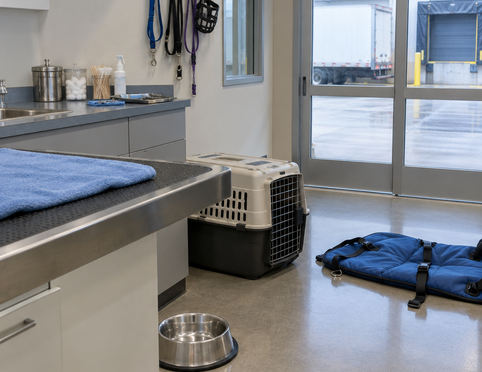
Across hovering around 50 early-puppy consultations in recent years, every handler sent a three-minute smartphone video of the hallway, sidewalk, or lobby where the first startle happened. Seeing the real location changes how a case gets read. A spot that looks harmless on paper often turns out to sit next to a loading dock or a clinic's automatic doors.
The same three triggers came up again and again:
- Sudden loud noises: air brakes, slamming metal, falling objects.
- Forced restraint at the vet clinic: being pinned for exams or vaccines while the puppy is still taking in the room.
- Unfamiliar off-leash dogs rushing in: fast, head-on approaches the puppy cannot escape.
Healthy recovery looks the same from one puppy to the next and takes 10 to 15 seconds. The puppy hops backward. It shakes off, starting at the head and finishing at the tail tip. Then it shifts its weight forward with a loose neck and goes to sniff the thing that scared it. If you see that full sequence, the puppy has handled the moment.
Fear imprinting looks different. The puppy avoids the area afterward, stays on alert, and panics more broadly when it returns to the place where the scare happened. Two cases show how the handler's first response shapes which path a puppy takes.
Bram and Tessie: one scare, two outcomes
Bram, a 9-week-old Golden Retriever, startled at a garbage truck's air brake from in the ballpark of 15 feet away. His handler shortened the leash and pulled him past the truck to "show him it was safe." Within four days, Bram refused to cross the front porch threshold whenever street noise rose above on the order of 65 decibels.
Tessie, a 10-week-old Border Collie mix, startled when a metal folding chair collapsed trending toward 8 feet away in a clinic lobby. Her handler stepped back 20 feet into an empty corridor, dropped a handful of freeze-dried beef liver on a rubber mat, and waited four minutes. Once Tessie's breathing fell below 40 breaths per minute, they left. Her next visit was uneventful.
Both puppies were similar in age and both triggers were sudden. The only real difference was whether the handler added distance or took it away.
When the Socialization Checklist Pushes Puppies Into Shutdown
Many puppy programs hand out checklists with dozens of new experiences to complete before 12 weeks. The goal is reasonable, since a well-socialized adult dog benefits from broad early exposure. The AVSAB Position Statement on Puppy Socialization makes a strong case for starting early. The problem is volume. Once owners treat the list as a quota, they stop watching the puppy and start counting items.
We stopped handing out a 100-item socialization bingo card a few years ago. Session notes showed owners holding squirming nine-week-olds near construction sites so they could tick off "loud machinery."
That is flooding. The puppy is held at full intensity with no way out. Some puppies scream. Many go still, and owners tend to read the stillness as calm. Repeated often enough, a puppy that cannot escape learns that nothing it does changes the outcome. That is the start of learned helplessness.
The baited trap
Food lures can do the same damage. A handler holds a high-value treat at nose level to draw the puppy within three feet of something scary. Look at the hind legs: they stay planted about 18 inches back while the neck stretches forward. The puppy eats, the food is gone, and the puppy bolts. It got pulled past its limit and paid for it as soon as the treat was swallowed.
Freezing Is a Warning Sign
Watch for a breath-hold of 2 to 4 seconds, dilated pupils with a crescent of white showing (whale eye), and quick tongue flicks that never reach the top of the nose. Sudden sniffing at nothing, a frozen posture, and a tucked tail belong on the same list. A puppy showing these signs is overwhelmed, even if it looks well behaved.
A Distance-First Exposure Plan the Puppy Controls
Start with the right equipment. Use 10-foot and 15-foot biothane long lines instead of a retractable leash. A fixed length gives you a physical measure of how far the puppy is comfortable being from a trigger.
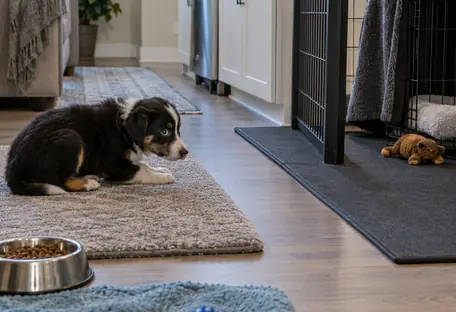
- Start far away. For anything that moves or makes noise (bicycles, skateboards, flapping tarps), begin with stationary watching at 35 to 50 feet.
- Let the puppy decide when to move closer. Step 5 feet closer only after the puppy turns its head back to you three times in a row on its own.
- Mark the look quickly. In Look-at-That (LAT), say "Yes" within a second or two of the puppy's ears turning toward the trigger.
- Feed at your side. Deliver a pea-sized piece of boiled chicken or cheddar at your pant seam, before the tail drops below the level of the spine.
- Keep sessions short. End while the puppy is still curious and loose.
This is classical counterconditioning. The distant sight or sound of the trigger starts to predict good food, and the puppy's emotional response shifts over time. Timing matters most. If food shows up after the puppy has stiffened, you are rewarding a puppy that is already afraid.
If a bad scare happens anyway
Signs of real panic include screaming, thrashing on the leash, or hiding under a car. Get distance right away, then scatter food in grass so the puppy can calm down by sniffing. For the next 48 hours, skip all off-property outings. Keep activity to backyard potty breaks and indoor sessions of cardboard shredding or snuffle-mat foraging, about 10 minutes each. That rest period matches the time cortisol needs to come back down.
A puppy that refused to leave the whelping box area at seven weeks, or that turns down food even in a quiet living room, needs a veterinary behavior evaluation before you try any of these field exercises.
Let the Head-Turns Decide
Base every step closer on the puppy's three voluntary check-ins with you. Your schedule and the checklist should not set the pace.
Keep Strangers' Hands Off Your Ten-Week-Old Puppy
Polite explanations rarely work in public. Strangers often keep reaching for the puppy's head while you are still apologizing. A quick physical block and one short sentence work far better.
Start the block when the person is still 8 to 10 feet away:
- Slide your dominant foot about 12 inches in front of the puppy's chest.
- Shorten the leash to about 24 inches, with no upward pull.
- Turn your shoulders squarely toward the stranger.
- Raise an open palm and say, flatly: "Stop, please, he is training."
- Turn 90 degrees right away and toss two treats onto the pavement behind your heels, so the puppy's head turns away from the stranger.
Some people will find this rude. Your puppy will learn something more important: when a stranger approaches, its person steps in, and nothing frightening happens.
Calm Distance First
A puppy that watches people pass calmly from a distance is building the foundation for a relaxed adult dog. Every forced greeting risks undoing that.
My recommendation is firm: from 8 to 12 weeks, allow no greetings from strangers or unfamiliar dogs, with no exceptions. Spend those four weeks teaching your puppy to watch the world calmly from a distance. Puppies raised this way learn that their handler will protect their space, and that trust makes defensive reactivity much less likely later in life.